Choosing among the best marine generators sounds simple until you actually start comparing them. A buyer may begin with, “I need an 8kW generator,” and within five minutes the real questions become: 8kW at 50Hz or 60Hz? Single-phase or three-phase? How much room is available? How many air-conditioning compressors start together? Is this a weekend boat, a liveaboard yacht, or a commercial vessel running thousands of hours?
That distinction matters because the best marine generator for a boat is not necessarily the brand with the biggest name, the highest kW rating, or the longest list of features. The best generator is the one that fits the vessel’s electrical load, installation space, operating profile, voltage and frequency, cooling arrangement, noise expectations, and future service needs.
Here is a representative scenario that captures the problem well. It is a composite example rather than a claim about one specific customer. A yacht owner wants to replace an aging 8kW genset and starts shopping exclusively for another 8kW marine generator. On paper, that sounds perfectly logical. But once you compare the old installation, you discover the replacement candidate is taller, the raw-water connection is on the opposite side, the exhaust outlet does not line up, the service panel cannot be accessed after installation, and its 50Hz/60Hz rating does not match what the buyer assumed. The generator wasn’t “bad.” It was simply the wrong generator for that boat.
That is why Marine Generators Depot approaches this comparison differently. We are not going to declare one brand the universal champion and then spend 3,000 words defending that decision. Instead, we will look at Cummins Onan, Kohler/Rehlko, Northern Lights, Fischer Panda, Westerbeke, Mase, Nanni, Paguro, Phasor, MER BOLLARD, and other important marine generator brands, depending on where each makes sense to include.
And there is plenty of legitimate variety between them. Cummins currently publishes an Onan recreational range from 4kW to 110kW; Fischer Panda USA concentrates its standard marine range between 5kW and 15kW; Northern Lights publishes marine products stretching from compact 5kW-class units into several-hundred-kilowatt yacht systems; and MER’s BOLLARD commercial range extends from 9kW to 392kW. Those are fundamentally different product strategies serving fundamentally different boats.
So someone looking for a 5kW marine generator for a sailboat should not evaluate brands in the same way as a captain choosing a 50kW commercial marine generator for a workboat. Likewise, a yacht owner prioritizing a quiet marine generator may place greater weight on enclosure design, vibration isolation, installation footprint, and operating speed than a commercial operator who cares primarily about duty cycle, serviceability, motor-starting capability, and downtime.
The same applies to generator size. We will compare popular 3kW, 5kW, 6kW, 8kW, 10kW, 12kW, 15kW and 20kW marine generators, as well as 30kW, 50kW, 100kW+ commercial marine gensets. But size is only one piece of the puzzle. A 10kW generator is not automatically “better” than an 8kW generator simply because the number is larger. Manufacturers themselves offer different ratings according to frequency, phase and model configuration; for example, Northern Lights’ M773LW3G is published at 9kW at 60Hz and 7kW at 50Hz.
This guide is therefore designed for three types of readers at once: the boat owner researching the best yacht generator, the buyer comparing brands before purchasing, and the vessel operator who already knows roughly what is needed and wants to narrow the shortlist. We will cover brand strengths, generator sizing, sound levels, 50Hz vs 60Hz, single-phase vs three-phase, low-speed vs high-speed gensets, installation considerations, replacement generators, parts support, and recreational versus commercial marine generators.
Most importantly, our comparisons will distinguish between manufacturer-published specifications and our own practical assessment of where a generator is likely to fit best. Specifications and model availability can change, so the final selection should always be checked against the manufacturer’s current data for the exact generator and the vessel’s installation requirements.
The short answer before we go any further is this:
There is no single best marine generator for every boat or yacht. The best choice is the generator that delivers the required electrical power while correctly matching the vessel’s duty cycle, electrical system, available space, cooling arrangement, noise expectations and long-term service requirements.
That principle will guide every comparison that follows.
If you do not want to read the entire guide before building a shortlist, start here.
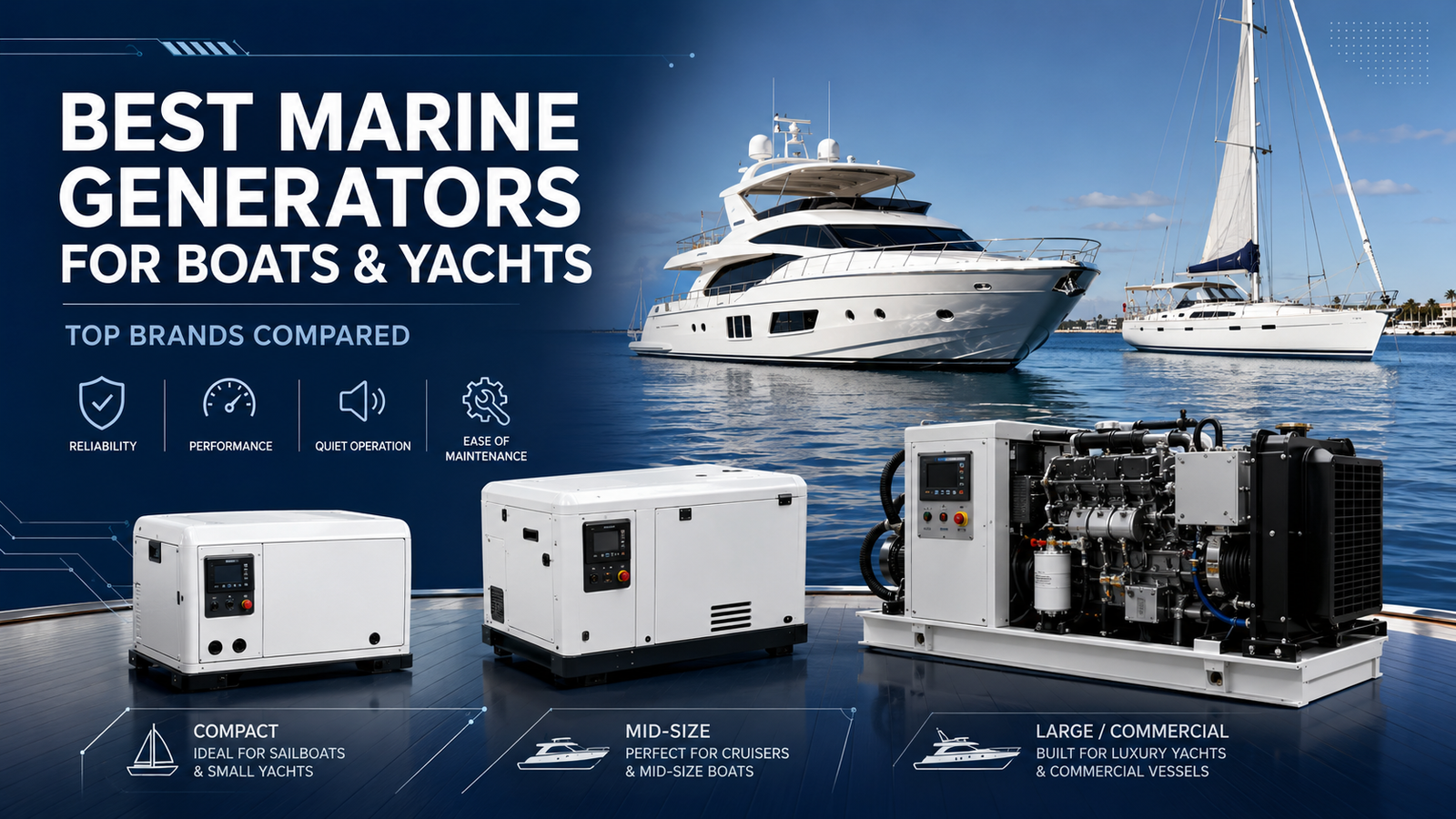
The table below summarizes several of the strongest marine generator brands by application type, for which we believe they deserve serious consideration. “Best for” is an editorial assessment by Marine Generators Depot based on product architecture, published model ranges and intended applications—it is not a manufacturer claim or a declaration that one brand will be best for every vessel.
Marine Generator Brand
Our Best-Fit Category
Current Range / Examples
Why It Makes the Shortlist
Cummins Onan
Best all-rounder for broad recreational choice
4kW–110kW
Broad boat and yacht generator range, 50/60Hz options and extensive support infrastructure.
Kohler / Rehlko
Best for established yacht and commercial installations
5kW models through large yacht systems of 200kW and above
Wide pleasure-craft portfolio, sound-management focus and large-vessel options.
Northern Lights
Best for traditional low-speed cruising and heavy-duty applications
5kW through 760kW published marine systems
Strong small-yacht, large-yacht and dedicated commercial ranges, including 1500/1800 RPM configurations.
Compact sound-insulated marine diesel generators with strong relevance to sailboats and space-conscious yachts.
Westerbeke
Best for recreational owners wanting diesel and gasoline choices
Approximately 3.5kW–29kW
Established small-to-mid-size marine range plus low-CO gasoline gensets and sound-enclosure options.
Mase
Best for buyers comparing conventional, inverter and variable-speed technology
Compact units through 30kW+ mainstream marine models, with much larger engineered systems
Particularly interesting where variable-speed, inverter or hybrid-ready generator technology is being considered.
Nanni
Best for yacht and professional European/international applications
Roughly 3.5kW–31kW in the currently published QMF/QMS/QLS ranges
1500 RPM options, heat-exchanger/keel-cooling choices and recreational/professional configurations.
Paguro
Best for compact sailboats and cruising yachts
3kW–22kW current published range
Strong emphasis on compact dimensions, water cooling and noise attenuation, with fixed- and variable-speed choices.
Phasor
Best for straightforward serviceable diesel gensets
3.5kW–99kW across current 50/60Hz listings
Kubota and John Deere-based systems, low-speed models and conventional service-focused architecture.
MER BOLLARD
Best for workboats and demanding commercial vessels
9kW–392kW
Purpose-focused commercial marine generators covering fishing vessels, tugs, passenger boats and other professional applications.
Notice something important about that table: the winners change when the job changes.
If somebody asks us, “What is the best 5kW marine generator for a sailboat?” Fischer Panda, Paguro, Westerbeke, Next Gen, Lombardini, and compact Mase models can all enter the conversation for different reasons. But if the question becomes, “What is the best 50kW marine generator for a commercial fishing vessel?” the shortlist changes dramatically toward brands such as MER BOLLARD, Northern Lights, Cummins and Phasor.
That is exactly why a generic “Top 10 Marine Generators” ranking can be misleading.
A generator’s badge tells you who made it. It does not tell you whether the machine is right for your vessel.
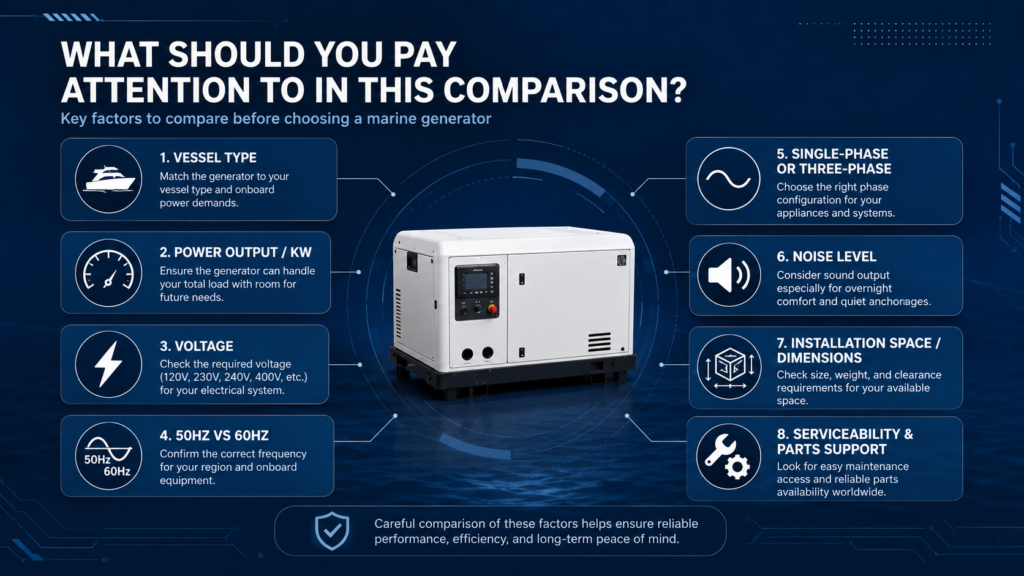
What Should You Pay Attention to in This Comparison?
For a pleasure boat, the priorities often include low noise, compact dimensions, vibration control, dependable AC output, and accessible routine maintenance. Fischer Panda’s current U.S. marine line, for example, explicitly focuses on compact, quiet diesel systems from 5kW to 15kW, while Paguro’s manufacturer emphasizes water cooling, sound insulation, and reduced physical dimensions.
For a larger cruising yacht, priorities may broaden to include 1500/1800 RPM operation, multiple generator sizes, sound enclosures, 50Hz or 60Hz availability, service support and redundancy. Northern Lights publishes everything from compact 5–40kW marine units to much larger yacht systems, while Cummins’ Onan range spans 4–110kW and explicitly offers both 50Hz and 60Hz families.
For commercial vessels, the equation changes again. Generator duty, motor starting, three-phase output, cooling arrangements and ease of repair can matter more than having the smallest possible enclosure. MER’s BOLLARD range, for example, begins at 9kW and extends through 392kW marine generator packages, while Northern Lights separately lists commercial units from roughly 20kW through 250kW in its current technical library.
And this leads directly to the framework we will use throughout the rest of this guide:
Do not ask only, “Which brand makes the best marine generator?”
Ask:
“Which generator is the best fit for this vessel, this electrical load, this installation, and this operating profile?”
That small change in the question produces a much better buying decision.
What Should You Pay Attention to in This Comparison
What Does “Best Marine Generator” Actually Mean?
When people search for the best marine generators, they are usually hoping for a simple answer: Buy Brand X. It is the best.
That would certainly make this article shorter.
It would also be poor advice.
A marine generator is not like choosing a television where the higher-spec model is usually the better product. It becomes part of the vessel itself—connected to the fuel system, cooling circuit, exhaust, electrical distribution, battery chargers, air-conditioning equipment and, ultimately, the way you use the boat.
So here is the clearest answer we can give:
The best marine generator is the one that can reliably supply your vessel’s real electrical demand while matching its voltage, frequency, duty cycle, installation space, cooling arrangement and service requirements—without being unnecessarily oversized.
That definition matters more than any brand ranking.
Cummins itself approaches generator selection by first estimating the vessel’s power requirements through its marine-generator sizing system. Fischer Panda gives essentially the same advice: generator size should be evaluated according to the actual electrical and comfort systems installed aboard the vessel because every boat is different.
That is also why simply searching for the biggest 10kW marine generator you can fit into the engine room is not necessarily the smartest buying strategy.
The Best Generator Is the One That Fits the Vessel
Imagine two owners both shopping for an 8kW marine generator.
The first owns a 42-foot cruising sailboat. The generator may mainly run battery chargers, refrigeration, a watermaker, and one air-conditioning unit during warmer evenings. Engine-room space is tight, and the generator sits relatively close to the sleeping accommodation. Compact dimensions and low noise matter enormously.
The second buyer operates a commercial fishing vessel. His generator may run pumps, refrigeration, electronics and other equipment for long operating periods. Service access, duty cycle, mechanical simplicity and the ability to obtain parts quickly may matter far more than shaving a few inches off the sound enclosure.
They may both need roughly 8kW.
They do not necessarily need the same generator.
This is where a lot of “best marine generator” lists go wrong. They compare specifications without first comparing applications.
A 5kW Fischer Panda generator, 5kW Westerbeke generator, 5kW Paguro marine generator and similarly sized unit from another manufacturer may all occupy roughly the same buying conversation, but their design philosophy, dimensions, operating characteristics, service arrangements and available configurations can differ substantially.
Likewise, once you move into 20kW marine generators, 30kW marine gensets or 50kW commercial marine generators, the purchasing priorities begin shifting toward heavier electrical loads, phase requirements, motor starting, cooling arrangements, prolonged operating hours and commercial serviceability.
So before asking which brand is best, we would ask: best for what?
A “Better” Brand Can Still Be the Wrong Generator
Suppose one generator has excellent published specifications, a respected manufacturer behind it and strong reviews from yacht owners.
Does that make it the best generator for your boat?
Not necessarily.
If it cannot physically fit through the machinery-space access hatch, the specifications do not help you.
If it is configured for 50Hz and your vessel requires 60Hz, brand reputation does not solve the problem.
If routine access to the oil filter requires removing half the generator enclosure because of the way it has been installed, you will remember that inconvenience at every service interval.
If your commercial vessel operates the generator extensively but the model was chosen primarily around occasional recreational use, the original comparison was incomplete.
And if you buy much more generator capacity than the boat actually needs because “bigger must be safer,” you may create another problem entirely.
Fischer Panda’s current generator-selection guidance specifically warns against both undersizing and excessive oversizing. Its technical guidance notes that insufficient output can lead to electrical problems, while a diesel generator continually operated at very light load can develop conditions associated with wet stacking and carbon buildup. Northern Lights similarly offers automatic load-bank systems for large yacht installations because maintaining appropriate generator loading can become an operational issue when major AC consumers are offline.
This gives us an important rule:
Do not size a marine generator according to fear. Size it according to load.
An owner who needs 7kW under realistic operating conditions does not automatically improve the installation by purchasing a 15kW marine generator.
There should be appropriate operating margin, of course. Compressors, pumps and electric motors can create substantial starting demand, and the generator needs enough capacity to handle realistic combinations of loads. But “appropriate reserve capacity” and “buy the largest generator that fits” are two very different strategies.
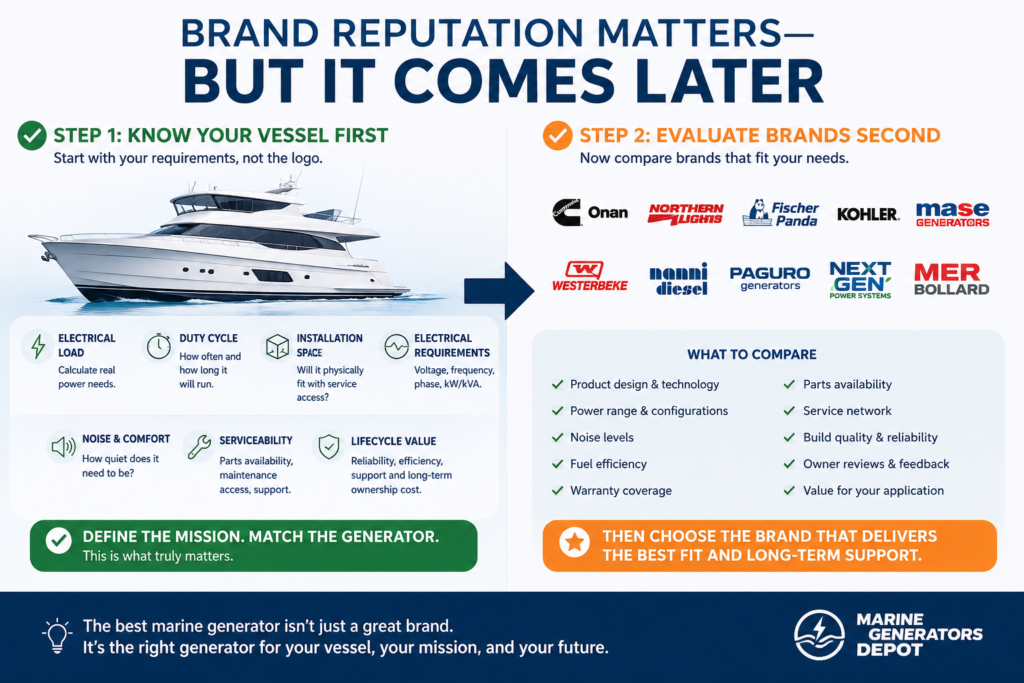
Brand Reputation Matters—But It Comes Later
None of this means the manufacturer is unimportant.
Far from it.
When Marine Generators Depot evaluates marine generator brands, we care about factors such as product range, technical design, parts availability, warranty structure, serviceability, manufacturer support, and suitability for the intended vessel.
A long-distance cruiser might reasonably place extra weight on marine generator parts availability and the ability to obtain service far from the home marina.
A luxury-yacht owner may prioritize a quiet yacht generator, sound enclosure, vibration isolation and minimal disruption to guest areas.
A sailboat owner may have such limited machinery space that compact dimensions become one of the deciding factors.
A workboat operator might place service access, cooling arrangement and commercial-duty suitability above practically everything else.
And a vessel replacing a discontinued genset may be constrained by the existing foundation, exhaust routing and machinery-space dimensions.
That is why brands should be compared after the application is understood, not before.
Cummins, for example, currently offers recreational Onan generators across a broad 4kW–110kW range and provides a dedicated sizing tool to help users estimate which genset best matches their power requirements. Its 6–8kW Onan QD platform also illustrates how even one product family can differ by frequency, voltage, phase and rated output.
This is a useful reminder that saying “I want an Onan” still leaves several technical questions unanswered.
The same applies to saying:
“I want a Northern Lights.”
“I want a Fischer Panda.”
“I need an 8kW boat generator.”
“I need the quietest generator.”
Those are useful starting points. They are not complete specifications.
Reliability Is Also About the Installation
There is another point that deserves more attention whenever people debate the most reliable marine generator.
Generator reliability is not determined solely inside the factory.
A high-quality marine diesel generator can still become troublesome when installed with inadequate cooling-water flow, poor engine-room ventilation, an incorrectly designed exhaust system, contaminated fuel, insufficient service clearance, or an electrical configuration that does not properly match the vessel.
Conversely, a correctly sized and properly installed generator that receives scheduled maintenance can provide a very different ownership experience.
This is why Marine Generators Depot separates two questions:
Is this a good generator?
and
Is this a good generator for this vessel?
The first question is about the product.
The second question is about the entire installation.
For a buyer, the second question is far more valuable.
Brand Reputation Matters—But It Comes Later
The Marine Generators Depot View
When we use terms such as best boat generator, best yacht generator, most reliable marine generator, or best commercial marine generator throughout this guide, we are not using them as absolute manufacturer rankings.
We are using them as best-fit categories.
A generator earns consideration because of how well its characteristics align with a particular type of vessel and operating requirement.
So a compact Fischer Panda or Paguro may rise toward the top when space and noise are major constraints. A low-speed Northern Lights system may become more interesting for a long-distance cruising yacht. Cummins Onan may appeal to buyers looking for a broad recreational power range and established service infrastructure. MER BOLLARD becomes much more relevant when we move into heavy-duty commercial marine generators. Those conclusions are based on the product architectures and applications the manufacturers themselves publish, not on the claim that any one brand is universally superior.
And that leads us to the method we will use to judge them.
Instead of starting with the logo on the sound shield, we start with the vessel.
The Marine Generators Depot 7-Factor Vessel Fit Framework
Once you stop asking, “Which brand is best?” and start asking, “Which generator actually fits this vessel?” the buying decision becomes much clearer.
At Marine Generators Depot, a useful way to compare the best marine generators is to evaluate them through seven practical factors: Load Fit, Duty-Cycle Fit, Installation Fit, Electrical Fit, Noise & Comfort Fit, Serviceability Fit, and Lifecycle Fit.
We call this the Marine Generators Depot 7-Factor Vessel Fit Framework.
The purpose is simple: prevent a buyer from choosing a generator based on one attractive specification—brand, price, kW rating, or noise level—while overlooking something that matters more after installation.
A 5kW marine generator that perfectly fits a sailboat can be a better purchase than a premium 8kW model that is too large, difficult to service, or poorly matched to the vessel’s electrical loads. Likewise, the best generator for a luxury yacht may be completely different from the right commercial marine generator for a workboat.
Here is how we evaluate the difference.
1. Load Fit: Can the Generator Handle What the Boat Actually Uses?
Start with the electrical load.
Not the boat’s length. Not what another owner installed. Not the largest generator that will physically fit.
The actual load.
Typical onboard consumers may include:
Marine air conditioning
Refrigerators and freezers
Battery chargers and inverter/chargers
Watermakers
Electric water heaters
Galley appliances
Pumps
Lighting
Navigation and communication systems
Entertainment systems
Commercial refrigeration or deck machinery
Some loads run continuously. Others cycle on and off. Motors and compressors can also require considerably more power during startup than during normal operation.
This is why an owner asking whether an 8kW marine generator is enough cannot get a responsible answer from generator size alone.
Two 45-foot yachts can have completely different electrical requirements.
One may operate primarily from batteries and use its generator for charging and occasional air conditioning. Another may have multiple HVAC compressors, an electric galley, watermaker, refrigeration, and several simultaneous hotel loads.
Same boat length. Very different generator requirement.
There should also be reasonable reserve capacity, but that does not mean buying the biggest genset possible.
The goal is a generator that comfortably handles realistic operating loads without spending most of its life dramatically underloaded.
That is Load Fit.
2. Duty-Cycle Fit: How Will the Generator Actually Be Used?
Next ask how often—and how hard—the generator will operate.
A privately owned sailboat running a 5kW boat generator for a few hours during anchorage is a very different application from a charter yacht operating its generator for long periods every day.
And both are very different from a fishing vessel where a 30kW or 50kW marine diesel generator may be supporting working loads throughout an extended operating schedule.
We generally think about applications such as:
Recreational use: Weekend boating, seasonal cruising and private yachts.
Liveaboard or long-distance cruising: More frequent operation and greater dependence on onboard electrical generation.
Charter operation: Higher annual hours and substantial hotel loads.
Commercial operation: Fishing vessels, workboats, passenger vessels and other applications where the generator can become mission-critical.
Duty cycle can influence the generator architecture that makes sense.
A compact high-speed genset may offer excellent packaging advantages for one recreational application, while a lower-speed 1800 RPM marine generator or commercial-duty configuration may be more attractive for another vessel expecting substantially higher annual operating hours.
It can also affect manufacturer warranty terms. Recreational and commercial applications do not always receive identical warranty coverage.
So when comparing the best yacht generators, always ask:
Best for how many hours of operation—and doing what?
3. Installation Fit: Will It Actually Fit the Machinery Space?
This sounds obvious.
It isn’t.
Generator dimensions are one of the easiest specifications to check and one of the easiest installation realities to underestimate.
You need to consider more than:
Length × Width × Height
You also need space to:
Remove filters
Change the raw-water impeller
Adjust or replace belts
Access wiring
Reach the control box
Service the cooling system
Remove enclosure panels
Inspect the exhaust
Eventually remove major components
A compact marine generator may therefore have an advantage that has nothing to do with its electrical output.
This is particularly important aboard sailboats, catamarans and smaller yachts, where Fischer Panda, Paguro, Next Gen, Mase and other compact-generator designs can enter the conversation specifically because installation volume is limited.
Weight matters too.
And then there is another dimension buyers sometimes discover too late:
Can the generator physically get into the boat?
Measure machinery-space access hatches, companionways, doors and removal routes—not just the final generator foundation.
For a replacement marine generator, compare the new unit with the existing genset for:
Overall dimensions
Mount spacing
Exhaust position
Raw-water connections
Fuel connections
Electrical connections
Service-side orientation
An 8kW generator replacing another 8kW generator is not automatically a drop-in replacement.
That is Installation Fit.
4. Electrical Fit: kW Is Only the Beginning
Suppose you have determined that approximately 10kW is appropriate.
Good.
You still haven’t finished specifying the generator.
You also need to establish:
Voltage: What voltage does the vessel’s AC distribution system require?
Frequency: Is the vessel designed around 50Hz or 60Hz?
Phase: Does it require single-phase or three-phase power?
kW vs kVA: How does the manufacturer rate the generator, and what usable real power is available for the intended electrical configuration?
This becomes especially important when comparing international generator models.
A 10kW marine generator at 60Hz should not automatically be treated as identical to a similarly named 50Hz version. The same generator family may have different published outputs according to frequency and configuration.
Large yachts and commercial vessels may also require three-phase marine generators for motors, pumps, refrigeration systems and other substantial loads.
The rule is straightforward:
Never buy a marine generator using kW alone. Confirm kW/kVA, voltage, frequency and phase as one electrical package.
For replacement installations, matching the existing electrical system can prevent expensive downstream changes to onboard appliances or distribution equipment.
That is Electrical Fit.
5. Noise & Comfort Fit: How Much Does Quiet Operation Matter?
This factor means very different things depending on the vessel.
On a commercial workboat, generator noise may be secondary to durability and serviceability.
On a luxury yacht where the generator compartment sits close to guest accommodation, it can become one of the most important purchasing considerations.
A quiet marine generator is not created by a single specification.
Noise and vibration depend on factors including:
Engine operating speed
Sound enclosure construction
Vibration mounts
Exhaust design
Machinery-space insulation
Ventilation
Generator loading
Installation quality
Brands including Fischer Panda, Mase, Paguro, Northern Lights, Cummins Onan and Kohler/Rehlko offer various approaches to sound attenuation across their product ranges.
But be careful when comparing published decibel figures.
A noise figure only becomes useful when the test conditions—distance, load, enclosure configuration and measurement method—are comparable.
Instead of chasing the smallest number on a brochure, ask:
What level of noise and vibration is acceptable aboard this particular vessel?
For a sailboat where the genset may run at night near the sleeping cabin, paying more attention to acoustic performance may be justified.
For a fishing vessel with a dedicated machinery room, another priority may matter more.
That is Noise & Comfort Fit.
6. Serviceability Fit: Can You Maintain It Without Hating It?
This is one of the least glamorous parts of buying a generator.
Now imagine having to remove cabinetry or half the sound enclosure every time you want to change an impeller.
That can turn a technically excellent generator into an unpleasant ownership experience.
Before choosing a model, look at where the routine service components are located and whether you can realistically reach them after the generator is installed.
Then look beyond the engine room.
Ask:
Are replacement parts readily identifiable?
Are filters and impellers easy to source?
Is technical documentation available?
Does the manufacturer maintain an established support network?
Are technicians in your cruising region familiar with the generator?
If something fails internationally, how difficult will obtaining parts be?
For someone cruising internationally, marine generator parts availability can sometimes matter more than saving a small amount on the initial purchase.
The cheapest generator on purchase day is not necessarily the cheapest generator to own.
That is Serviceability Fit.
7. Lifecycle Fit: Think Beyond the First Season
Finally, ask what ownership could look like five, ten, or more years from now.
Marine generator purchasing should not be reduced to:
Purchase price = total cost
A better view considers the generator’s lifecycle.
That includes:
Routine maintenance
Service-part availability
Manufacturer support
Warranty coverage
Fuel consumption
Major component access
Expected operating hours
Future parts supersession
Potential resale implications
Replacement compatibility
This is particularly important when comparing a lower-priced generator with a more established platform.
A generator may be attractive today, but what happens when you need an alternator component, control module, water pump, or exhaust component several years later?
Likewise, brand recognition alone is not enough. An established manufacturer may still offer multiple models with very different installation and operating characteristics.
Lifecycle Fit therefore means evaluating the entire ownership period, not merely whether the generator starts on delivery day.
For commercial operators, this calculation becomes even more important because downtime has a financial cost. A 50kW commercial marine generator that is easier to maintain and supported by readily available service parts may provide better economic value than a cheaper machine that is difficult to repair when the vessel is working.
Best Marine Diesel Generators
Put the Seven Factors Together Before Choosing the Brand
Here is the complete Marine Generators Depot Vessel Fit Framework:
1. Load Fit — Does it handle the actual electrical demand?
2. Duty-Cycle Fit — Is it appropriate for how frequently and heavily the vessel will use it?
3. Installation Fit — Does it physically fit with practical service access?
4. Electrical Fit — Do kW/kVA, voltage, frequency,y and phase match?
5. Noise & Comfort Fit — Is its acoustic and vibration performance appropriate for the vessel?
6. Serviceability Fit — Can it be maintained and supported where the boat operates?
7. Lifecycle Fit — Does the generator still make sense when you consider years of ownership rather than just purchase price?
This framework also explains why we will not simply rank every manufacturer from #1 to #10.
Consider three hypothetical buyers:
A sailboat owner might score compact dimensions and quiet operation very highly and ultimately prefer a 5kW Fischer Panda, Paguro, Next Gen or Mase marine generator.
A long-range motor yacht owner might place greater weight on low-speed operation, serviceability and parts support, putting Northern Lights, Cummins Onan, Kohler/Rehlko, Nanni or Westerbeke into a different kind of comparison.
A commercial operator looking for a 50kW–100kW marine generator may place duty cycle, three-phase capability, cooling configuration and service access above sound-enclosure size, bringing MER BOLLARD, Northern Lights, Cummins or Phasor toward the front of the discussion.
Nobody has to be wrong.
They are solving different problems.
And that is the most important principle to carry into the brand comparison:
Brand comes after vessel fit—not before it.
When those seven factors are understood, comparing the best marine generator brands becomes far more useful because you are no longer asking which manufacturer has the strongest marketing reputation. You are asking which manufacturer offers the right generator for the way your boat or yacht actually operates.
What is the best marine generator for a boat?
There is no single best marine generator for every boat. The right choice depends on electrical load, vessel type, installation space, voltage, frequency, operating hours, noise expectations, and service availability. Compact brands may suit sailboats and smaller yachts, while low-speed or commercial-duty generators may be better for high-hour vessels.
What size marine generator do I need for my boat?
Start by calculating the electrical equipment likely to operate simultaneously, then account for starting loads from air conditioners, pumps and motors. Boat length alone should not determine generator size. Manufacturers such as Cummins and Fischer Panda likewise recommend sizing according to actual onboard electrical demand.
Is a 5kW marine generator enough for a boat?
A 5kW marine generator can be enough for many smaller sailboats and cruising boats with moderate loads such as battery charging, refrigeration, lighting and limited air conditioning. A vessel with several HVAC compressors, an electric galley or large hotel loads may require 8kW, 10kW or more.
What is the quietest marine generator for a yacht?
There is no universally quietest generator because published sound figures depend on test conditions and installation. For a quiet yacht generator, compare the sound enclosure, vibration mounts, operating speed, exhaust system and machinery-space insulation. Fischer Panda, Rehlko/Kohler, Mase, Paguro and Northern Lights all offer products or enclosure systems aimed at noise-sensitive yacht applications; Rehlko specifically highlights redesigned sound shields and vibration isolation in its pleasure-craft range.
Is an 8kW or 10kW marine generator better?
Neither is automatically better. An 8kW marine generator is the better choice when it comfortably handles the vessel’s realistic load with appropriate reserve capacity. A 10kW marine generator becomes appropriate when the electrical demand justifies the additional output. Oversizing solely for extra capacity is not necessarily beneficial.
Should I buy a 50Hz or 60Hz marine generator?
Buy the frequency that matches the vessel’s electrical system and connected equipment. Do not choose between 50Hz and 60Hz marine generators based on geography alone. The same generator family can have different output ratings at different frequencies; Cummins, for example, publishes marine models with distinct 50Hz and 60Hz configurations.
Which marine generator is best for a commercial vessel?
For a commercial vessel, prioritize duty cycle, serviceability, cooling arrangement, phase requirements, motor-starting capability, parts availability, and operating hours rather than sound level alone. Larger commercial applications may lead buyers toward Cummins, Northern Lights, MER BOLLARD or Phasor depending on the required output and vessel. Northern Lights, for example, publishes dedicated commercial marine generators from smaller sets through 250kW-class units.
Need Help Comparing Marine Generators for Your Vessel?
The best generator decision starts with the boat—not the brand name on the enclosure.
If you’re comparing a 5kW boat generator, an 8kW or 10kW yacht generator, a 20kW marine diesel generator, or a larger commercial marine generator, Marine Generators Depot can help you narrow the options based on your actual vessel requirements.
Send us your vessel type, existing generator model if applicable, required kW or kVA, voltage, 50Hz or 60Hz frequency, phase, installation dimensions,s and delivery destination. We can then help you compare suitable generator brands and configurations for a new installation or replacement project.
The objective isn’t simply to buy one of the best marine generators. It is to put the right generator in your boat.


Comment (1)
[…] is where our separate Best Marine Generators for Boats & Yachts comparison becomes […]