
If you’re asking “what size marine generator do I need?”, there is one principle worth remembering before looking at brands, prices, or boat-length charts:
The right marine generator size is determined primarily by the electrical loads your vessel will realistically operate at the same time, the starting requirements of motors and compressors, and the electrical system the generator must supply.
Boat length can give you context. It cannot give you the final answer.
Fischer Panda’s current marine-generator guidance makes essentially the same point: because every vessel has a different combination of electrical equipment and comfort systems, generator sizing should be evaluated as part of the boat’s overall electrical design rather than selected from vessel size alone. Cummins likewise provides a dedicated marine generator sizing resource designed to estimate power requirements according to the application.
Consider a practical example. This is a representative sizing scenario, not a story about a specific Marine Generators Depot customer.
Two owners each have a 42-foot yacht.
The first yacht has one air conditioner, modest refrigeration, a battery charger, a water heater and a few occasional AC appliances.
The second yacht has three HVAC zones, a watermaker, induction cooking, a large inverter/charger, extensive refrigeration and several hotel loads that may operate together.
Same boat length.
Very different generator requirement.
The first owner might reasonably end up comparing 5kW, 6kW or 8kW marine generators. The second may find that an 8kW, 10kW, 12kW or larger yacht generator better matches the actual load calculation.
That is why Marine Generators Depot recommends a load-first approach.
Let’s work through it properly.
The fastest responsible answer is:
Calculate the electrical loads that will realistically operate at the same time, identify significant motor and compressor starting requirements, allow appropriate operating headroom, and then match the result to a marine generator with the correct voltage, frequency, phase, duty rating and installation characteristics.
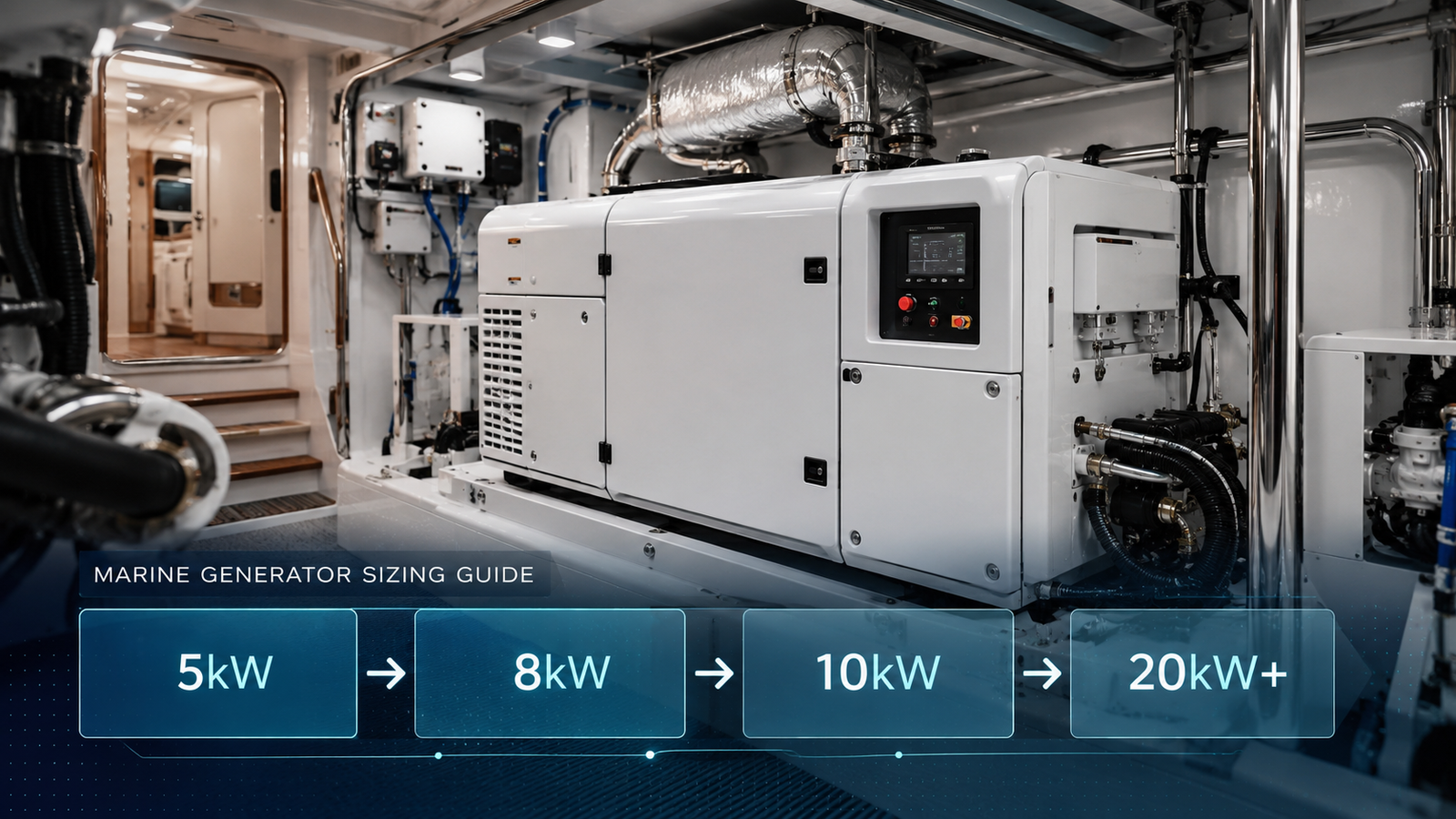
For shopping purposes, buyers frequently encounter generator classes such as:
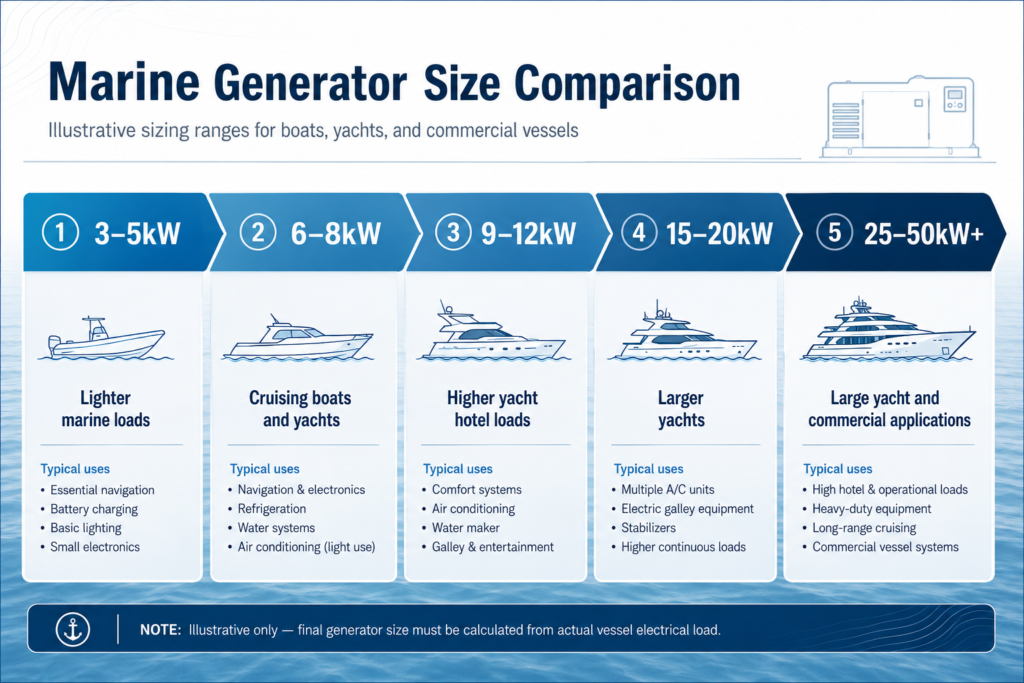
| Generator Class | Common Market/Application Context |
|---|---|
| 3kW–5kW marine generators | Compact marine gensets and lighter onboard AC requirements |
| 5kW–8kW marine generators | Popular recreational boat and cruising-yacht range |
| 8kW–12kW marine generators | Mid-range yacht and higher hotel-load applications |
| 12kW–20kW marine generators | Larger recreational and professional-vessel loads |
| 20kW–50kW+ marine generators | Large-yacht and commercial marine power |
| 50kW–100kW+ marine generators | High-demand yacht, commercial and specialized vessel systems |
These are shopping categories, not sizing prescriptions.
Cummins’ current Onan recreational range illustrates the breadth of actual product sizes available: its marine portfolio starts around 4kW and extends to 110kW, including families in the 4–5kW, 6–8kW, 7–9kW, 9–13kW and larger classes.
A larger boat often has more electrical equipment, but there is no reliable formula such as:
40-foot boat = 8kW generator
or:
50-foot yacht = 12kW generator
One 50-foot yacht might use propane cooking, batteries and an inverter to handle many short-duration loads. Another may rely heavily on electric cooking, water heating, HVAC and high-rate battery charging.
Generator sizing therefore follows the electrical system—not simply the hull length. Fischer Panda specifically advises evaluating the actual electrical equipment installed aboard the vessel.
Undersizing is a real problem, but solving it by purchasing the largest generator that physically fits can create another poor match.
Large diesel generators that spend extended periods at insufficient load can operate less favorably. Northern Lights specifically discusses the problem on larger yachts: when major AC consumers are offline, generator loading can become too low, contributing to smoke, soot and reduced overall efficiency. Northern Lights offers automatic load banks specifically to add or remove supplemental load as vessel demand changes.
So the goal is not:
The goal is:
appropriate generator capacity.
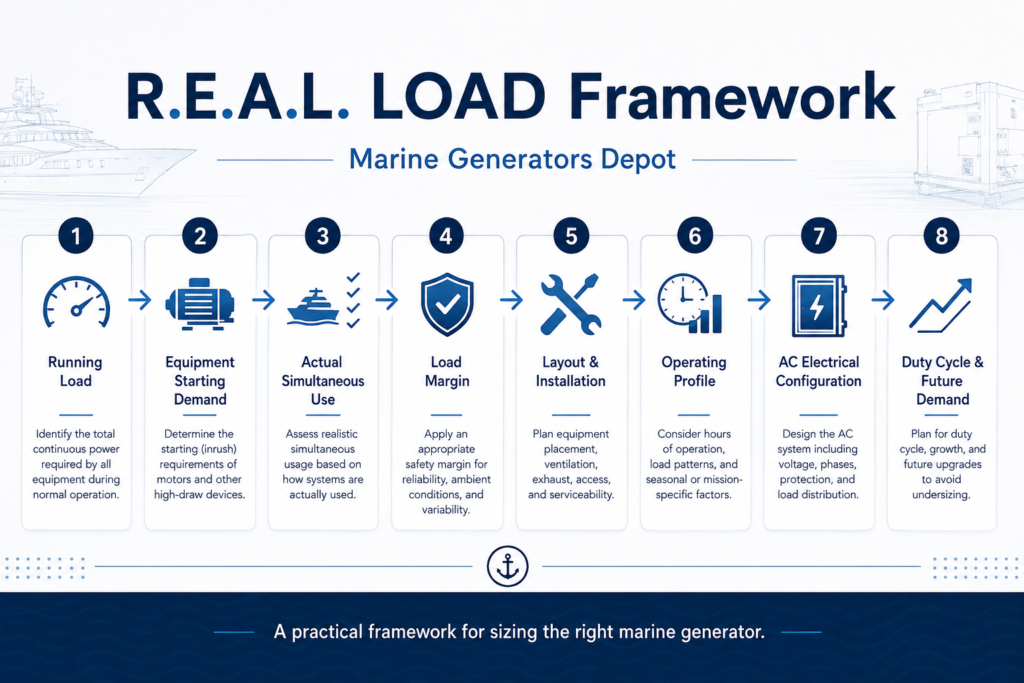
To make marine generator sizing easier to apply, Marine Generators Depot uses an eight-point framework:
R — Running Load
E — Equipment Starting Demand
A — Actual Simultaneous Use
L — Load Margin
L — Layout & Installation
O — Operating Profile
A — AC Electrical Configuration
D — Duty Cycle & Future Demand
Most sizing mistakes happen because somebody considers only the first item.
A proper generator decision considers all eight.
Start by listing the AC equipment the generator may need to operate.
Typical loads can include:
Use actual equipment nameplates or manufacturer documentation whenever possible.
If the equipment rating is given in watts:
1,000 watts = 1kW
So 6,500 watts represents 6.5kW of real power.
Do not stop there.
Motors and compressors can create a considerably larger electrical demand when starting than once they are running.
This is especially important with:
Micro-Air’s technical generator-sizing guidance recommends starting with the actual equipment nameplate information and distinguishes a generator’s continuous capacity from short-duration starting capability. Its guidance also points out that other loads already operating when an air conditioner starts must be included in the calculation.
This is a common reason why a generator that looks sufficient on paper may struggle in real operation.
Imagine your boat has 5.5kW of equipment running comfortably.
Then a large air-conditioning compressor attempts to start.
The question is no longer:
Can the generator carry 5.5kW?
It becomes:
Can it carry the existing load while successfully handling that starting event?
That is a very different calculation.
Now comes one of the most useful sizing questions:
What will actually run at the same time?
Suppose a yacht contains:
Adding every nameplate rating may create a theoretical load that rarely, if ever, occurs.
Instead, build a realistic operating scenario.
Perhaps the owner intentionally turns off the water heater while using the induction cooktop.
Perhaps the air conditioners are sequenced rather than allowed to start together.
Perhaps the washing machine is normally used while another high-demand appliance is off.
This is load management.
And sometimes intelligent load management is better than permanently installing several additional kilowatts of generator capacity solely to cover an unusual combination of loads.
The generator should not be sized with no breathing room.
A reasonable operating margin provides capacity for variations in demand, charging loads, starting events and future additions.
But there is an important distinction:
Headroom is capacity you have a realistic reason to need. Oversizing is capacity you are unlikely to use.
There is no single reserve percentage that is universally correct for every boat.
A professionally designed vessel with automatic load management can have different requirements from a recreational boat where loads are switched manually and unpredictably.
Use actual operating conditions to establish margin instead of choosing an arbitrary number from the internet.
Electrical sizing tells you how much generator you need.
Installation determines what you can actually use.
Record:
Then ask the question that can ruin an otherwise perfect purchase:
Can the generator actually get through the access opening?
Also leave enough room for maintenance.
Cummins’ current 6–8kW Onan QD family, for example, publishes dimensions around 664 × 583 × 535 mm for the referenced configuration and notes that dimensions can vary according to specification. Larger 9.5–13.5kW Onan models have substantially different installation dimensions.
Similar kW does not mean similar physical size.
ABYC maintains dedicated standards covering AC generator sets and associated boat electrical systems, underscoring that a marine genset is part of a complete vessel installation rather than merely a standalone appliance.
Next ask:
How will this generator live?
A weekend cruiser running its generator occasionally has a very different operating profile from:
Runtime matters.
Load consistency matters.
Service access matters.
The relative importance of low noise, compact packaging, long-duration operation and commercial serviceability changes according to the vessel’s mission.
This is why a westerbeke generators 5kW yacht generator and a 50kW commercial marine generator cannot be evaluated using exactly the same priorities.
Do not stop once you know the kW requirement.
You still need to confirm:
Cummins’ marine generator listings demonstrate why this matters. Its Onan families are offered in different 50Hz and 60Hz configurations, and model output can vary according to the electrical specification.
A generator with the right nominal kW but the wrong electrical configuration is still the wrong generator.
Finally, look forward.
Are you planning to add:
Future demand deserves consideration.
But once again, planned demand is different from speculative demand.
Size for a realistic electrical plan rather than every upgrade somebody might install someday.
Here is the practical process.
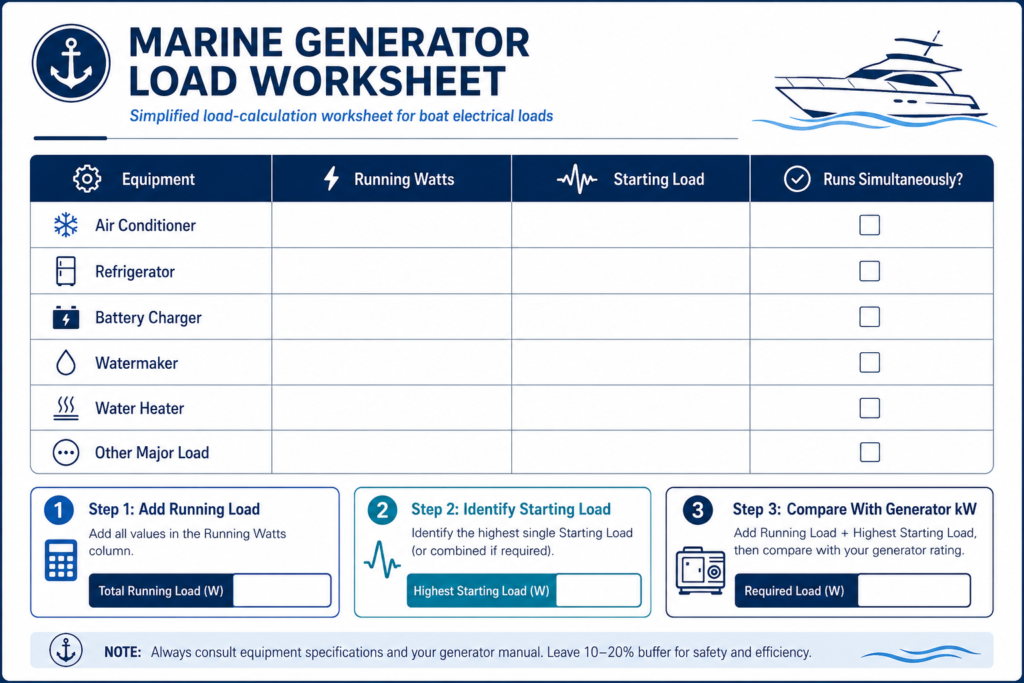
Create a table using actual equipment data.
| Load | Voltage | Running W/A | Starting Requirement | Runs Simultaneously? |
| Air conditioner #1 | ||||
| Air conditioner #2 | ||||
| Refrigerator | ||||
| Battery charger | ||||
| Watermaker | ||||
| Water heater | ||||
| Microwave | ||||
| Other major load |
Do not estimate if you can obtain the real nameplate rating.
For equipment already specified in watts:
Watts ÷ 1,000 = kilowatts
So:
8,000 W = 8kW.
For AC equipment specified primarily in amperes, use the appropriate electrical calculation for the actual system and account for power factor where applicable. For anything beyond a straightforward single-phase load inventory—particularly three-phase equipment or significant motors—have the calculation reviewed by a qualified marine electrician or electrical engineer.
ABYC specifically covers AC generator sets, AC/DC electrical systems and three-phase AC systems on boats within its marine electrical standards and certification curriculum.
Do not total the entire boat unless the entire boat can genuinely demand power simultaneously.
Build scenarios such as:
Normal overnight operation
Cooking
Maximum HVAC operation
Watermaking
Heavy battery charging
Commercial working condition
Then determine which scenario creates the highest realistic demand.
Determine what large motor or compressor could start while the normal running loads are already online.
This is particularly important for marine HVAC. Micro-Air notes that generator selection should use continuous capacity and include auxiliary loads present when the compressor starts.
Now provide a reasonable margin for actual operation.
Do not confuse margin with buying twice the generator you need.
At this point you can meaningfully compare:
5kW marine generators
6kW marine generators
8kW marine generators
10kW marine generators
12kW marine generators
15kW marine generators
20kW marine generators
and larger systems.
Look at the manufacturer’s continuous output for the exact voltage/frequency configuration, not just the number used in a model name.
Here is a deliberately simplified educational example.
Assume our 42-foot yacht has:
Suppose the realistic simultaneous running demand under one operating scenario works out around 5.5–6.0kW.
That immediately tells us something.
A 5kW marine generator would not provide adequate continuous capacity for that scenario.
An 8kW marine generator may deserve investigation.
A 10kW marine generator may also deserve investigation if the largest compressor-starting event, charging demand or realistic future load requires more headroom.
But we cannot responsibly declare either one the winner until the motor-starting requirement and exact generator performance are checked.
Notice what we did not do:
42 feet = 10kW.
Instead:
Loads → starting demand → margin → generator shortlist.
That is the more defensible sizing process.
People search extensively by generator size, so understanding the common classes is useful.
Just remember: these are product categories, not boat-length formulas.
A 3kW, 4kW or 5kW marine generator sits in the compact end of the market.
This class is often investigated where:
Fischer Panda is one manufacturer that specifically markets compact marine diesel generators for onboard requirements ranging from basic electrical needs to higher-demand comfort systems.
A 6kW or 8kW marine generator is a popular comparison range for recreational cruising boats and yachts.
Cummins currently offers its Onan QD family in 6, 7.5 and 8kW variants according to electrical configuration.
Again, that does not mean every cruising yacht needs 8kW.
It means this is a widely available product class worth investigating when your calculated demand points in that direction.
The 10kW marine generator search often falls into product families whose exact published ratings may be 9.5kW, 11kW, 11.5kW, 13.5kW or similar.
Cummins currently offers an Onan QD family covering that 9.5–13.5kW range.
This capacity becomes relevant as simultaneous HVAC, charging, galley and watermaking loads increase.
A 15kW or 20kW marine diesel generator may enter the shortlist for larger yachts or electrically intensive recreational and professional vessels.
At this point, careful evaluation of phase, motor loads and distribution architecture becomes increasingly important.
Larger yachts and commercial vessels can move quickly into 20kW, 30kW, 40kW and 50kW marine generator territory.
Cummins currently offers Onan marine products in the 22.5–29kW class and larger QD systems extending from 40kW up to 110kW.
Commercial systems can extend considerably beyond those outputs.
At this level, professional load studies and system engineering should replace rough online sizing estimates.
For many recreational vessels, marine air conditioning is the single most important generator-sizing load.
Why?
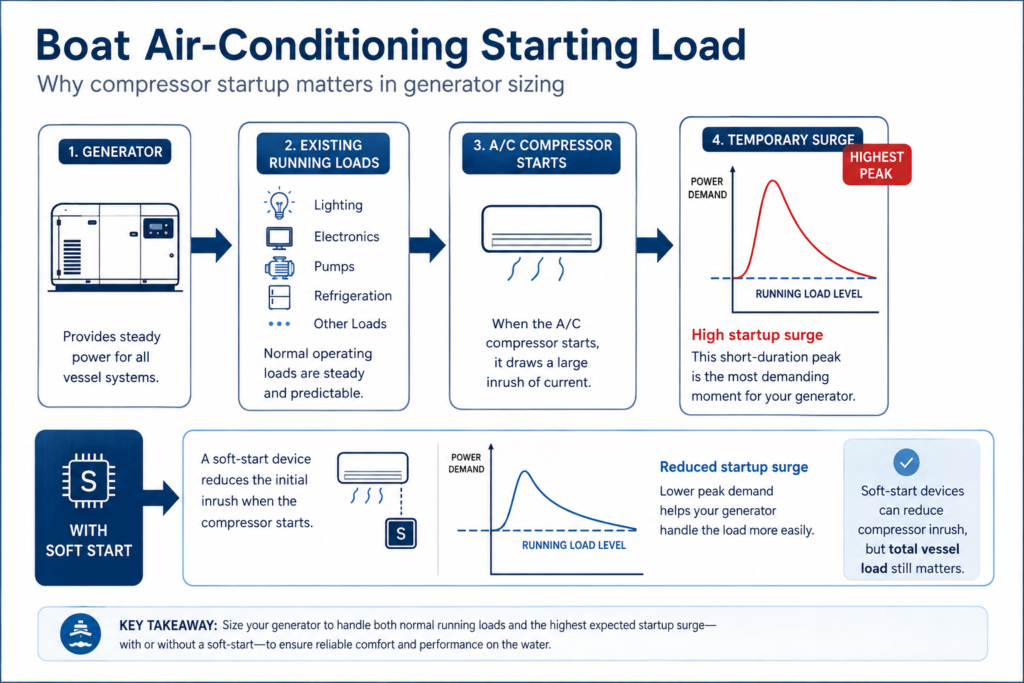
Because compressors combine substantial running demand with a potentially demanding startup event.
A compressor may draw significantly more current at startup than during normal operation.
Micro-Air’s manufacturer guidance tells users to obtain compressor and fan current from the equipment nameplate and calculate total operating power before comparing it with the generator’s continuous rating. Its generator-sizing guidance also emphasizes that additional loads must be included when the air conditioner starts.
Knowing that an air conditioner is 12,000, 16,000 or 24,000 BTU tells you cooling capacity.
It does not give you a complete electrical starting calculation.
Use the manufacturer’s electrical specifications.
Three air conditioners already running create one condition.
Three compressors attempting to start together can create another.
Sequencing starts can therefore materially change the peak demand seen by the generator.
A suitable soft-start device can reduce compressor inrush.
Micro-Air specifically markets its EasyStart systems for applications where marine air conditioners must operate from limited generator or inverter capacity and publishes separate generator-selection guidance for those installations.
But this does not mean:
“Install a soft start and buy any smaller generator.”
The entire vessel load still matters.
Use the soft-start manufacturer’s specifications together with the HVAC and generator manufacturer data.
A 5kW marine generator is enough only when the vessel’s realistic continuous load and starting requirements fit within the exact generator’s capabilities with appropriate operating margin.
It may be perfectly suitable for one boat.
It may be badly undersized for another boat of exactly the same length.
A 5kW boat generator is most logically investigated when onboard AC demand is relatively modest or actively managed.
If normal operating demand is already approaching 5kW before an air-conditioning compressor starts, move the analysis upward rather than hoping the generator will tolerate constant operation near its limit.
An 8kW marine generator may be appropriate when realistic simultaneous running demand plus significant starting events can be handled comfortably by that generator’s exact continuous and transient capability.
This class is attractive because several manufacturers offer products near it, giving buyers meaningful choices in size, sound enclosure, operating speed and service arrangement.
Cummins’ current QD family provides 6–8kW models depending on frequency and specification.
Do not automatically choose 10kW because it is larger.
If your peak realistic requirement fits comfortably within the capabilities of the 8kW candidate, the smaller generator may offer advantages in:
If your calculated demand is already approaching the 8kW generator’s limits, the 10kW-class system becomes a much more credible candidate.
Let the numbers make the decision.
A 10kW, 12kW or 15kW marine generator small diesel generator generally enters the discussion because the vessel has accumulated substantial simultaneous loads.
Common drivers include:
Battery charging deserves particular attention.
A large charger can represent a significant continuous AC load precisely when the battery bank is depleted and the owner is most likely to be running other equipment.
Larger yachts and commercial craft can have fundamentally different power systems.
High-demand systems may include:
Fishing vessels, passenger vessels and workboats can add:
Three-phase power becomes increasingly important as large motor loads appear.
ABYC maintains a dedicated TE-12 Three-Phase AC Electrical Systems on Boats standard in addition to A-27 for generator sets and E-11 for AC/DC boat electrical systems.
At this level, generator sizing should be reviewed professionally.
Here’s the contrarian part of this guide:
Buying more kW than your vessel can realistically use is not automatically an upgrade.
Marine diesels need to operate under meaningful load.
Northern Lights explains that low generator loading on large yachts can lead to smoke, soot and lower efficiency when major AC consumers are offline. Its load-bank system adds supplemental kW specifically to keep generator operation within appropriate conditions.
Headroom gives you realistic spare capacity.
If an 8kW generator meets every normal and reasonable peak condition, installing 20kW “just to be safe” deserves scrutiny.
Ask why that additional 12kW is needed.
If the answer is one rare combination of appliances, load management may be the more elegant solution.
Marine generators may be advertised in kW, kVA, or both.
Kilowatts represent real power—the power doing useful work.
Kilovolt-amperes represent apparent power.
The relationship is commonly expressed as:
kW = kVA × power factor
That means a 10kVA rating does not automatically equal 10kW unless the applicable power factor is 1.0.
This becomes especially important when comparing generators from different markets or manufacturers.
If you are uncertain about kVA, power factor or three-phase calculations, use manufacturer data and have the final selection checked by a qualified marine electrical professional.
Frequency must match the vessel’s electrical architecture.
Do not select it from your current geographic location alone.
Cummins currently offers Onan marine generator families in both 50Hz and 60Hz, with output ratings varying according to model and electrical configuration.
A vessel designed for 60Hz power does not become a 50Hz vessel simply because it crosses the Atlantic.
Changing frequency may affect connected equipment and requires proper system evaluation.
Single-phase generation is common on recreational vessels.
Larger yachts and commercial craft increasingly use three-phase systems where larger motors and machinery are involved.
This matters because generator sizing is not only about total real power.
Motor starting characteristics, phase balance, voltage and distribution architecture can all affect the generator requirement.
ABYC’s marine electrical curriculum specifically covers AC generator installation, AC/DC systems and three-phase boat electrical systems.
The output number is not the only choice you will make.
Traditional four-pole generator systems commonly operate around:
1500 RPM for 50Hz
1800 RPM for 60Hz
They remain common in recreational and commercial marine generator ranges.
Higher engine speeds can allow smaller and lighter generator packages, which can be valuable where machinery-space is restricted.
Variable-speed systems use power electronics to produce the required AC output while allowing engine speed to vary with operating conditions.
The correct architecture depends on:
Do not assume one architecture is universally superior.
This is where modern marine electrical design gets interesting.
A generator does not necessarily have to supply every short-duration load directly if a properly engineered battery/inverter system can carry those peaks.
Victron’s marine system guidance makes an important distinction between power and energy: adding up watts alone does not describe how long equipment operates, while inverter sizing needs to account for continuous and peak loads.
Potentially.
An inverter can support short high-demand loads from the battery bank while the generator operates more strategically.
Victron’s PowerAssist concept, for example, allows the battery/inverter system to assist a limited AC source during peak demand, while PowerControl manages charging so the available source is not overloaded.
But there is another side.
A large lithium battery bank may accept substantial charging power.
The inverter/charger itself can become one of the generator’s largest sustained loads.
So the correct question is not:
Generator or batteries?
It is:
How should the generator, battery bank, inverter/charger, alternators, solar and shore power work together?
Replacing an old generator is a perfect opportunity to redo the sizing calculation.
Do not automatically assume:
Old generator: 8kW
New generator: 8kW
Your vessel may have changed.
Perhaps you added:
Or perhaps new inverter/battery technology has reduced how often large loads must be supplied directly by the generator.
Recalculate.
Then compare the physical installation.
Record:
Cummins’ current product data illustrates why this matters: its 6–8kW and 9.5–13.5kW QD families differ substantially in physical dimensions and weight, even before configuration-specific differences are considered.
Same power neighborhood does not mean drop-in replacement.
Once the load calculation is complete, you can compare brands intelligently.
The smaller 3kW–8kW marine generator market includes products from manufacturers such as:
Around 8kW–20kW, buyers can find models from brands including:
Above 20kW, choices extend into larger recreational and commercial systems from manufacturers including:
This is where our separate Best Marine Generators for Boats & Yachts comparison becomes useful.
Sizing tells you how much generator you need.
Brand comparison helps determine which generator in that size class best fits your vessel.
Boat length is context—not a load calculation.
Running watts alone can underestimate the difficulty of starting HVAC compressors and motors.
Installed load and realistic simultaneous load are not always the same.
Reserve capacity is useful. Large amounts of unused diesel-generator capacity deserve justification.
Always compare the manufacturer’s actual electrical rating.
The right kW at the wrong frequency is still the wrong generator.
Measure service access and the route into the machinery space—not just the generator footprint.
ABYC maintains separate standards addressing AC generators, AC/DC electrical systems, batteries, inverters and three-phase systems because marine power generation is an integrated safety-critical installation.
Before comparing generators, collect:
For complex systems, high-power commercial installations, substantial three-phase motor loads, or major electrical redesigns, have the final specification reviewed by an appropriately qualified marine electrical professional.
Here is the entire guide reduced to one process:
Calculate realistic simultaneous running load → identify significant starting loads → add justified operating headroom → confirm voltage/frequency/phase → check installation and duty requirements → compare real generator models.
You may end up with a 5kW marine generator.
You may need 8kW.
It might be 10kW, 15kW, 20kW or 50kW.
The number should be the result of the analysis, not your starting assumption.
Remember:
A 5kW generator does not automatically mean “small boat.”
A 10kW generator does not automatically mean “40-foot yacht.”
A 20kW generator does not automatically mean “commercial vessel.”
The electrical system decides.
Choose a marine generator based on the vessel’s realistic simultaneous electrical load, significant motor/compressor starting demand, appropriate operating margin, and required voltage, frequency and phase. Do not size from boat length alone. Fischer Panda specifically recommends evaluating the actual equipment installed on the vessel, while Cummins provides application-based generator sizing resources.
List the AC loads that can run simultaneously, determine their running demand, identify significant motor or compressor starting requirements, and then add justified operating headroom. Compare that result with the manufacturer’s continuous ratings for the exact electrical configuration.
It can be. A 5kW boat generator is sufficient when the vessel’s realistic continuous and starting loads remain within that generator’s capabilities. It cannot be determined accurately from vessel length alone.
Possibly. You need the HVAC system’s actual running and compressor-starting requirements plus the other loads that will already be on the generator when the compressor starts. Micro-Air’s generator-selection guidance specifically recommends including auxiliary loads in this calculation.
Choose the smallest appropriate generator that comfortably supports the calculated operating and starting requirements with suitable headroom. Do not automatically move to 10kW unless the load analysis justifies the additional capacity.
Some reserve capacity is prudent, but excessive oversizing is not automatically beneficial. Northern Lights specifically addresses low-load generator operation with automatic load banks designed to maintain appropriate loading on large-yacht systems.
Use the frequency required by the vessel’s electrical distribution system and connected equipment. Cummins offers marine generator models in both 50Hz and 60Hz and publishes configuration-specific ratings.
kW represents real power. kVA represents apparent power. They are related through power factor, so a 10kVA generator does not necessarily provide 10kW of real power.
It can change the optimal generator strategy because an inverter/battery system may support short-duration peaks while the generator handles charging and sustained loads. However, high-rate battery charging can itself become a significant generator load. Victron’s marine system guidance treats batteries, inverter/chargers and generation sources as parts of one integrated energy system.
Not automatically. Recalculate the current vessel loads and compare voltage, frequency, phase, dimensions, mounting arrangement, cooling, exhaust and controls. Equal kW does not guarantee electrical or physical compatibility.
If you’re comparing a 5kW boat generator, an 8kW marine generator, a 10kW yacht generator, a 20kW marine diesel generator, or a larger commercial marine generator, Marine Generators Depot can help you narrow the available options using the information that actually matters.
Provide your vessel type, existing generator information, AC load list, voltage, frequency, phase, air-conditioning specifications, inverter/charger details, available installation dimensions and intended recreational or commercial use.
For replacement projects, include clear photographs of the existing generator nameplate and machinery-space installation whenever possible.
The objective is not to put the largest generator you can afford into the boat.
It is to identify the generator that can support the vessel’s real electrical requirements, fit the installation properly, operate in the correct electrical environment and remain practical to own and service.
That is what good marine generator sizing actually means.
This guide was developed using current technical information from Cummins/Onan Marine, Fischer Panda, Northern Lights, Micro-Air, Victron Energy, and American Boat & Yacht Council (ABYC) resources. Final generator selection should always be verified against the current specifications and installation instructions for the exact generator and vessel.

Comment (1)
[…] current public listing might show a 5kW marine generator price around $10,000–$11,000, but that tells you nothing yet about freight, installation or what […]