If you are searching “marine generator cost”, you probably do not want a vague answer like “it depends.”
You want to know what a real generator is likely to cost, why one 5kW marine generator can be thousands of dollars more than another, what installation adds to the bill, and whether paying more upfront actually saves money later.
So here is the useful answer first:
A new marine generator can range from roughly the high four figures for some compact models to well above $20,000–$30,000 for larger yacht generators, before freight, installation, accessories, commissioning, taxes, or vessel modifications. Large commercial marine generators are increasingly quotation-specific and can cost considerably more.
As of August 2026, public U.S. dealer listings provide a useful snapshot. Beta Marine USA currently lists compact 3.5kW generator sets from about $8,500 and 5.5kW units from about $10,350, while Bosch Marine lists Cummins Onan models at about $10,693 for 5kW, $14,963 for 9kW, $18,590 for 13.5kW, $24,439 for 21.5kW, and $28,845 for 29kW. These are examples of advertised equipment prices—not universal market prices or installed-project totals. (Beta Marine USA Parts)
Here is a representative situation that explains why the sticker price can mislead. This is a composite buying scenario, not a claim about a specific Marine Generators Depot customer.
One yacht owner sees a 6kW generator advertised for about $10,000. Another 6kW unit appears closer to $13,000. At first glance, the cheaper machine looks like the obvious deal. Then you notice that the more expensive configuration includes the sound shield the yacht actually needs. A current Kohler/Rehlko 6EKOD listing illustrates this perfectly: the advertised 6kW version without a sound shield is about $10,088, while the sound-shielded version is about $12,837. Same nominal kW. Very different package.
That is why Marine Generators Depot approaches marine generator pricing differently.
The real question is not:
“What is the cheapest generator?”
It is:
“What will the right generator cost to buy, configure, deliver, install, commission, maintain, and support on this vessel?”
There is no single universal marine generator price, but current published U.S. dealer listings give us a useful market reference.
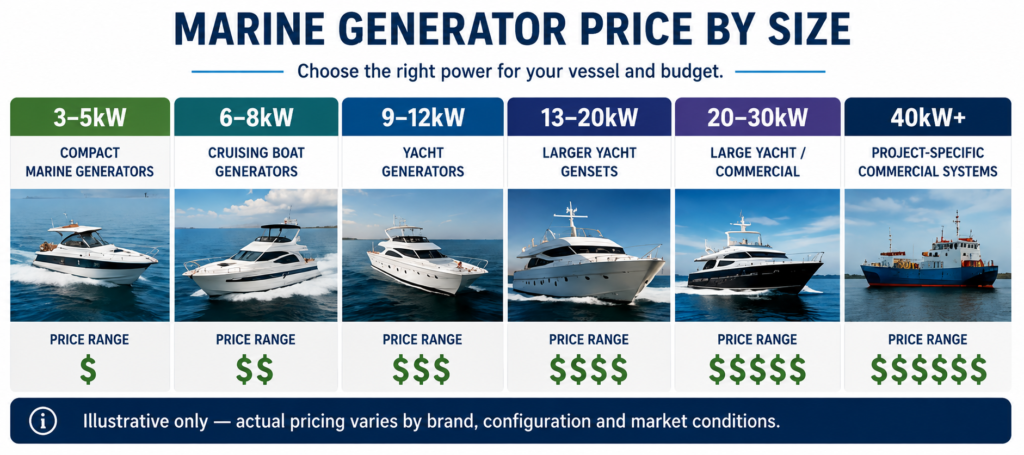
The table below uses real publicly advertised examples available at the time of writing. It should be treated as market orientation, not a promise that every brand or configuration will fall inside these numbers.
Generator Size
Current Public Price Examples
Typical Buying Context
3–5kW
About $8,500–$10,700
Sailboats, compact cruisers, lighter hotel loads
6–8kW
About $10,000–$13,300
Cruising boats and yachts
9–12kW
About $11,300–$17,100
Mid-size yachts, HVAC and larger hotel loads
13–20kW
About $15,000–$21,100
Larger yachts and higher simultaneous demand
20–30kW
About $17,000–$28,900
Large yachts and commercial applications
40kW+
Commonly quote-specific
Large yachts, commercial and specialized vessels
These figures are derived from current public listings including Beta/NextGen, Phasor and Cummins Onan products. They are not intended to represent the cheapest or most expensive generator available in each category.
Cummins’ current recreational Onan portfolio itself extends from 4kW to 110kW, while Northern Lights publishes technical information for marine generator sets from around 5kW through systems reaching several hundred kilowatts. Once you leave the small recreational-genset market, generator configuration becomes increasingly project-specific.
Generator Price vs Installed Price
These are two different numbers.
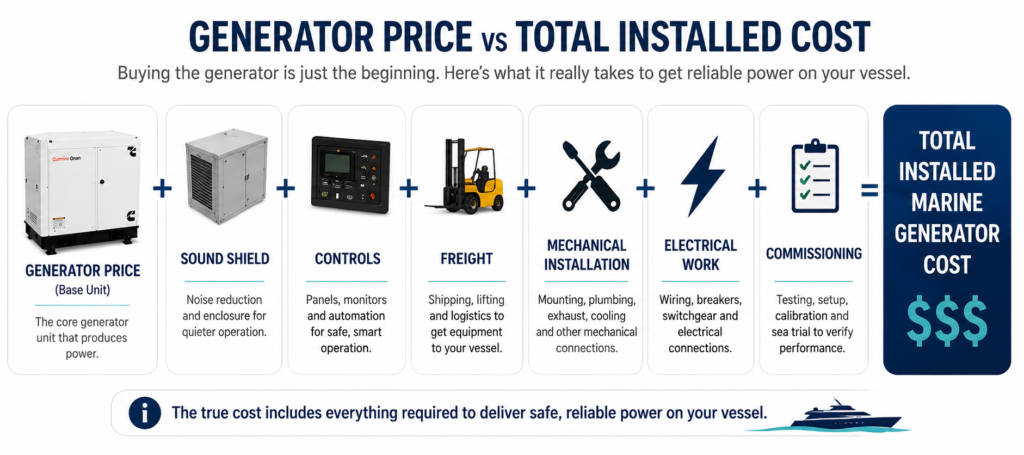
The generator price is what you pay for the genset and whatever components are included in that specific package.
The installed marine generator cost may also include:
Sound enclosure
Remote control panel
Wiring harnesses
Flexible mounts
Exhaust components
Waterlock or muffler
Raw-water plumbing
Fuel-system components
Circuit protection
AC cabling
Structural work
Freight
Crane or hoist access
Removal of the previous generator
Technician labor
Commissioning and testing
ABYC treats the marine generator as part of a wider vessel system, with standards covering AC generator sets, AC/DC electrical systems, exhaust installation, inverters, batteries and three-phase systems. That is a good reminder that installation is more than simply bolting a generator to the deck. (The American Boat & Yacht Council)
Why Online Marine Generator Prices Vary So Much
When comparing advertised prices, check whether you are actually comparing the same package.
Differences can include:
Sound shield included or excluded.
50Hz vs 60Hz configuration.
Single-phase vs three-phase.
Remote panel and harness included or optional.
Different controller packages.
Ignition-protection certification.
Current inventory vs special order.
Freight included or excluded.
Retail list price vs discounted dealer price.
For example, Beta Marine USA currently lists its 5.5kW generator at $10,350 and the sound-enclosed version at $11,600. Its 9.5kW version is listed at $12,750 open and $14,050 with the enclosure.
The lesson is simple:
Never compare marine generator prices until you compare what each price actually includes.
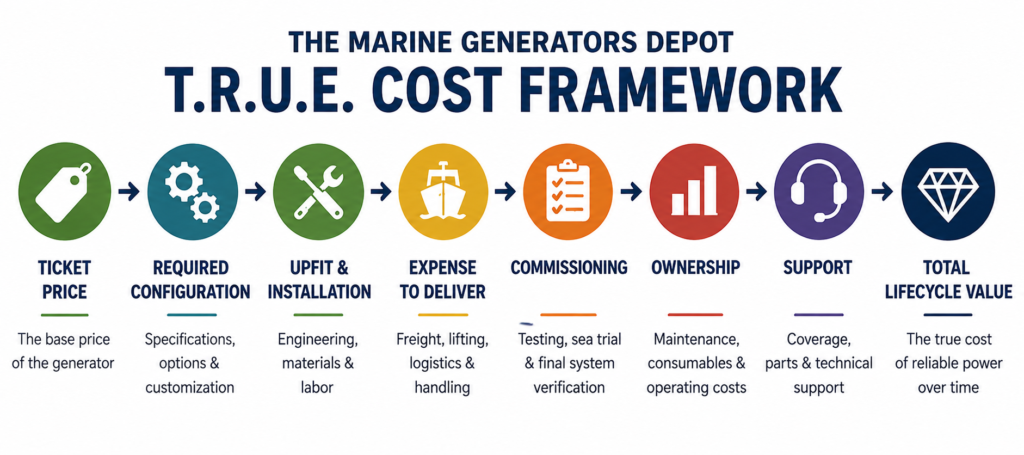
The Marine Generators Depot T.R.U.E. COST Framework
To make this easier, Marine Generators Depot uses a practical framework we call T.R.U.E. COST.
T — Ticket Price
This is the advertised generator price.
It is important.
It is also just the beginning.
A current public listing might show a 5kW marine generator price around $10,000–$11,000, but that tells you nothing yet about freight, installation or what accessories your vessel needs.
R — Required Configuration
Ask exactly what your vessel needs.
That can include:
Sound enclosure
50Hz or 60Hz
120V, 120/240V, 230V or other voltage
Single- or three-phase output
Remote start/stop
Digital display
Harness
Ignition protection
Keel-cooling arrangement
Special controls
Configuration can shift price significantly without changing the basic kW rating.
U — Upfit & Installation
What must change aboard the vessel?
A replacement generator that lands neatly on an existing foundation can be a much less expensive project than one requiring a new base, exhaust rerouting, raw-water plumbing, cable changes and control-system work.
E — Expense to Deliver
Marine generators are heavy.
A 5kW Cummins Onan QD model is published at roughly 166 kg/365 lb, while larger generator families can weigh hundreds or thousands of pounds. Freight method and unloading requirements therefore matter. (Cummins Inc.)
C — Commissioning
Installation is not complete simply because the generator is physically mounted.
A proper startup should verify relevant fuel, cooling, exhaust, electrical, frequency, voltage and load performance.
ABYC’s marine electrical certification program specifically addresses installation, operation and troubleshooting of AC generators as part of safe marine electrical practice.
O — Ownership & Maintenance
Budget for:
Engine oil
Oil filters
Fuel filters
Raw-water impellers
Belts
Coolant
Anodes where applicable
Heat-exchanger service
Scheduled maintenance
Eventual major repairs
S — Support & Warranty
Parts access, documentation, warranty and service availability have economic value.
A generator that saves $1,500 upfront but becomes extremely difficult to support in your cruising region may not be the lower-cost choice over ten years.
T — Total Lifecycle Value
Now put the entire picture together.
Marine generator cost should be evaluated as a project and an ownership decision—not simply as a product price.
Current public U.S. listings put some compact new marine generator sets in roughly the $8,500–$10,700 range before installation and freight.
Beta Marine USA lists a 3.5kW unit at about $8,500 and a 3.5kW sound-enclosed version at about $9,775. Its 5.5kW model is currently advertised at $10,350 without the enclosure. Bosch Marine lists a Cummins Onan 5kW unit at $10,693. (Beta Marine USA Parts)
That makes 5kW marine generator cost one of the more approachable entry points into new diesel marine generation—but do not assume every 5kW system will cost about $10,000.
Why Two 5kW Generators Can Cost Very Different Amounts
Compact engineering costs money.
Fischer Panda’s current 5kW AC generator, for example, is supplied as a compact freshwater-cooled package with a sound enclosure, remote panel, harness and remote fuel lift pump. That package architecture is very different from an open generator where several of those elements may be separate options.
Technology, weight, sound attenuation, packaging, controls and what comes standard can therefore matter as much as output.
How Much Does a 6kW–8kW Marine Generator Cost?
This is one of the most popular recreational ranges.
Current examples include:
Phasor 6.5kW Compact — about $10,175
Kohler/Rehlko 6kW open — about $10,088
Phasor 8kW Compact — about $11,020
Kohler/Rehlko 6kW sound-shielded — about $12,837
Cummins Onan 7.5kW — about $13,230
That is an excellent example of why an 8kW marine generator price cannot be reduced to a simple “dollars per kilowatt” formula.
You are comparing different engines, controls, enclosures, generator architecture, certifications and standard equipment.
How Much Does a 9kW–12kW Marine Generator Cost?
A buyer searching for a 10kW marine generator price will often encounter generators rated at 9kW, 9.5kW, 11kW, 11.5kW or 12.5kW rather than an exact 10.0kW.
Current examples include:
Phasor 9.5kW — about $11,320
Beta/NextGen 9.5kW — about $12,750 open
Cummins Onan 9kW Space Saver — about $13,408
Beta/NextGen 9.5kW with enclosure — about $14,050
Cummins Onan 9kW — about $14,963
Cummins Onan 11.5kW — about $17,069
This segment commonly appears on cruising yachts where multiple air conditioners, refrigeration, watermaking, battery charging and galley loads begin increasing the electrical requirement.
How Much Does a 13kW–20kW Marine Generator Cost?
This is where yacht generator cost begins climbing into the mid-to-upper teens and beyond.
Current public examples include:
Phasor 14kW Compact — about $15,190
Phasor 17.5kW Standard — about $16,080
Cummins Onan 13.5kW — about $18,590
Cummins Onan 17kW — about $21,080
At these outputs, optional three-phase capability, larger sound enclosures, remote instrumentation and vessel-specific installation work can materially change the project total.
How Much Does a 20kW–30kW Marine Generator Cost?
Current examples show just how wide this category can be.
Phasor currently lists a 21kW standard generator around $17,015 and a 30kW model around $22,525. Cummins Onan listings show approximately $24,439 for 21.5kW and $28,845 for 29kW.
So if someone asks:
“What does a 20kW marine generator cost?”
the defensible answer is:
Current publicly listed new 20–30kW marine generators can range from the high teens into the upper-$20,000s before installation, depending heavily on manufacturer and configuration.
That is much more useful than pretending one price applies to the entire segment.
What Does a 40kW–50kW+ Commercial Marine Generator Cost?
Once you enter larger commercial marine generator territory, public retail prices become less useful.
Systems may need to be configured around:
Voltage
Three-phase output
Motor-starting requirements
Sound enclosure
Keel cooling or heat exchanger
Vessel class requirements
Parallel operation
Load sharing
Control architecture
Cummins’ current Onan QD line includes 40–110kW systems in both 50Hz and 60Hz configurations and with or without sound enclosures. Northern Lights publishes marine products beginning around 50kW and extending through several hundred kilowatts.
For those applications, configuration-specific quotation is usually more meaningful than a generic online price range.
Kohler/Rehlko provides a particularly useful example of option pricing.
A currently listed 6EKOD 6kW marine diesel generator is advertised around $10,088 without a sound shield and about $12,837 with the sound shield.
That difference of roughly $2,749 is not an abstract pricing theory. It demonstrates exactly why two apparently identical “6kW Kohler generator prices” can be very different.
Northern Lights has a wide product portfolio, covering roughly 5–40kW recreational-class systems before expanding into 50kW+ yacht and commercial generator ranges.
Public prices vary considerably by dealer and configuration, so Marine Generators Depot would treat current Northern Lights pricing as model-specific rather than publish a universal brand-wide price range.
Fischer Panda USA currently focuses on a standard marine range from approximately 5kW to 15kW, with an emphasis on compact, freshwater-cooled sound-insulated generators.
Its 5kW AC product, for example, includes a sound enclosure, remote-control panel, harnesses and remote fuel lift pump as standard. The 15kW-class AC 15 DP similarly includes the sound enclosure and controls.
That is why direct price comparisons should account for package content.
Westerbeke occupies both diesel and gasoline marine-generator markets. When comparing Westerbeke with diesel-only brands, fuel type and product architecture should be treated as part of the cost comparison rather than comparing kW alone.
These manufacturers cover a range of compact and mid-size marine-generator applications, but publicly advertised U.S. pricing is not always consistent enough to support one trustworthy universal number.
For these brands, the better comparison is an exact model quotation including:
Phasor’s manufacturer literature shows a broader product lineup using Kubota or John Deere engines depending on output, including models extending to 99kW.
MER BOLLARD & Large Commercial Generator Pricing
For BOLLARD and other large commercial generator systems, the useful number is normally a project-specific price.
A workboat requiring three-phase output, keel cooling and special controls should not be priced as if it were simply a larger version of a recreational yacht generator.
What Actually Makes One Marine Generator More Expensive?
Let’s strip away the branding for a moment.
Diesel vs Gasoline
Fuel type affects engine design, ignition protection requirements, vessel compatibility and long-term operating considerations.
The “cheaper generator” is only relevant if it is appropriate for the vessel’s fuel system and intended application.
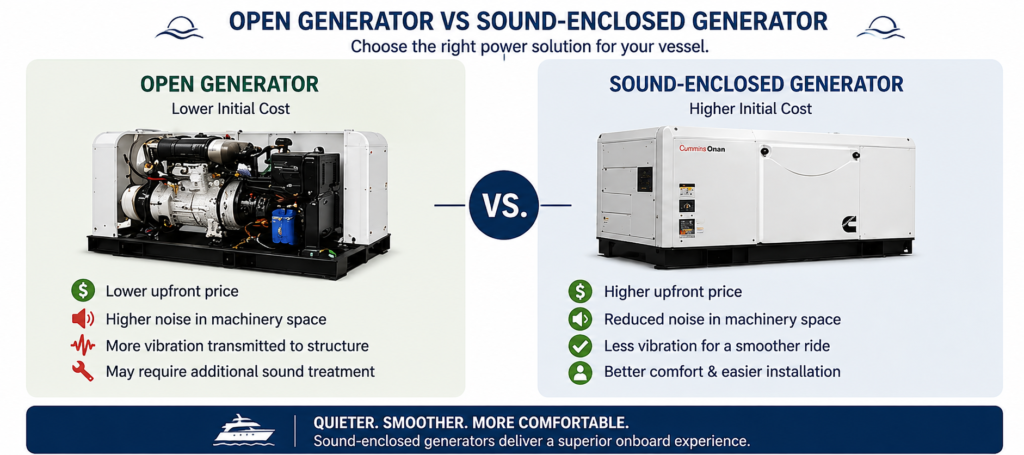
Sound Enclosure
Sound shields add material, engineering, access panels and acoustic treatment.
The current Rehlko/Kohler 6kW example shows an advertised difference of roughly $2,749 between open and sound-enclosed configurations. Beta’s current listings similarly show about $1,250 additional cost for the enclosure on its 5.5kW generator and about $1,300 on its 9.5kW model.
Fixed-Speed vs Variable-Speed Technology
Traditional fixed-speed generators and inverter/variable-speed systems solve the same fundamental problem in different ways.
Fischer Panda’s current 5.5e, for example, combines an inverter with a compact freshwater-cooled diesel generator and sound shield. Technology like that should not be compared on kW alone with a conventional open fixed-speed genset. (Fischer Panda Generators)
50Hz vs 60Hz
Frequency can change:
Generator RPM
Output rating
Voltage options
Regional specification
Cummins’ current Onan families are published in 50Hz and 60Hz variants, and their kW ratings can differ by frequency. (Cummins Inc.)
Single-Phase vs Three-Phase
Three-phase systems are increasingly relevant as loads and motor sizes grow.
ABYC maintains a separate TE-12 standard for three-phase AC electrical systems on boats, reinforcing that phase configuration is a meaningful system-design issue rather than a cosmetic option. (The American Boat & Yacht Council)
Engine & Alternator Size
Higher output generally requires more substantial engines and generator ends.
But price does not rise at a constant rate per kilowatt.
We will return to that shortly.
Controls & Remote Displays
Digital displays, remote start/stop, fault monitoring, network integration and longer harnesses can all alter the package cost.
Cooling Configuration
Heat-exchanger and keel-cooled systems can require different hardware both within the generator and aboard the vessel.
Certifications and Commercial Requirements
Ignition protection, emissions requirements and commercial-vessel specifications can also affect configuration.
Cummins specifically identifies ignition-protected 4–5kW, 6–8kW and 7–9kW Onan families for applicable recreational installations.
Sound Shield vs Open Generator: Is It Worth Paying More?
For many yacht owners, yes.
But not always.
Why Sound Enclosures Cost More
A proper sound shield is not just a decorative box.
It has to provide acoustic attenuation while still allowing:
Service access
Cooling
Cabling
Plumbing
Structural integrity
Fischer Panda’s entire marine design philosophy, for example, uses freshwater cooling to help allow its generators to sit inside compact sound-insulated capsules without relying on surrounding air to cool the alternator.
Who Should Prioritize a Sound Shield?
Sound attenuation is particularly valuable for:
Sailboats
Cruising yachts
Liveaboards
Charter yachts
Generators near sleeping accommodation
When an Open Generator May Make More Sense
An open generator can be reasonable where:
The vessel already has a sound-treated machinery space
Commercial service access is more important than accommodation comfort
The generator is installed far from passenger areas
Compare the Installation, Not Just the dB Number
Published sound levels should be compared only when the test distance and conditions are reasonably similar.
Do not spend thousands chasing a lower brochure number without considering the exhaust system, vibration isolation and machinery-space treatment.
How Much Does Marine Generator Installation Cost?
This is where I would resist anyone who offers one universal answer.
Marine generator installation cost is vessel-specific.
Two identical 10kW generators can have dramatically different installation costs.
New Installation vs Replacement
A new installation may require:
Fuel supply and return
Raw-water intake
Seacock
Strainer
Exhaust
AC cabling
Circuit protection
Start battery
Controls
Foundation
Ventilation
A replacement may allow some infrastructure to be reused if it is compatible, serviceable and appropriate for the new generator.
Simple Replacement vs Full Repower
The cheapest replacement projects occur when the new genset closely matches the existing installation.
The project becomes more expensive when you must change:
Foundation
Mounting pattern
Exhaust
Cooling
Electrical output
Controls
Access structure
Installation Labor
Depending on the project, you may need both mechanical and electrical expertise.
ABYC certification content treats AC generator installation, operation and troubleshooting as a distinct marine electrical skill area.
Exhaust-System Costs
A wet-exhaust installation can involve:
Exhaust hose
Waterlock or muffler
Mixing elbow
Siphon protection
Through-hull arrangement
ABYC’s standards list includes P-1 for installation of exhaust systems for propulsion and auxiliary engines. (The American Boat & Yacht Council)
Cooling-System Costs
Depending on the generator, installation may require or modify:
Seacock
Strainer
Raw-water hose
Anti-siphon loop
Heat exchanger
Keel-cooling circuit
Fuel-System Costs
New supply and return lines, filters, shutoffs and tank connections may be necessary.
Electrical Installation Costs
The generator must integrate safely with:
AC distribution
Breakers
Transfer arrangements
Start battery
Charging system
Remote control panel
ABYC’s E-11 standard covers AC and DC electrical systems on boats, while A-27 addresses AC generator sets.
Generator Mounts & Structural Work
A new foundation can turn a routine replacement into a fabrication project.
Crane, Hoist & Access Costs
A generator weighing several hundred pounds may need:
Crane
Forklift
Yard lift
Temporary removal of hatches or furniture
Always inspect the access route before ordering the generator.
The Hidden Costs of Buying a Marine Generator
These are the costs that rarely fit neatly into the product-price box.
Freight
Beta Marine USA explicitly notes that shipping is additional on its generator listings, while the Kohler/Rehlko 6kW listing identifies LTL freight as the delivery method.
Marina, Residential & Liftgate Delivery
Commercial freight delivery can become more expensive when a location lacks a loading dock or forklift.
International Freight
International generator purchases may involve:
Ocean freight
Air freight
Forwarding
Export packaging
Documentation
Import Duties, VAT & Brokerage
These depend on destination and commercial terms and should be confirmed before purchase.
Installation Accessories
A low generator price may become less attractive after adding:
Remote panel
Harness
Mounts
Muffler
Siphon break
Fuel separator
Exhaust separator
Service kit
Fluids & Initial Service Materials
Coolant, oil and spare filters should be accounted for where not already supplied.
Commissioning
Professional testing can identify issues before they become expensive failures.
Old Generator Removal
Removing the existing unit can involve almost as much access planning as installing the new one.
Vessel Downtime
For recreational owners, downtime is inconvenient.
For commercial and charter operators, downtime has economic value.
That belongs in the ownership calculation.
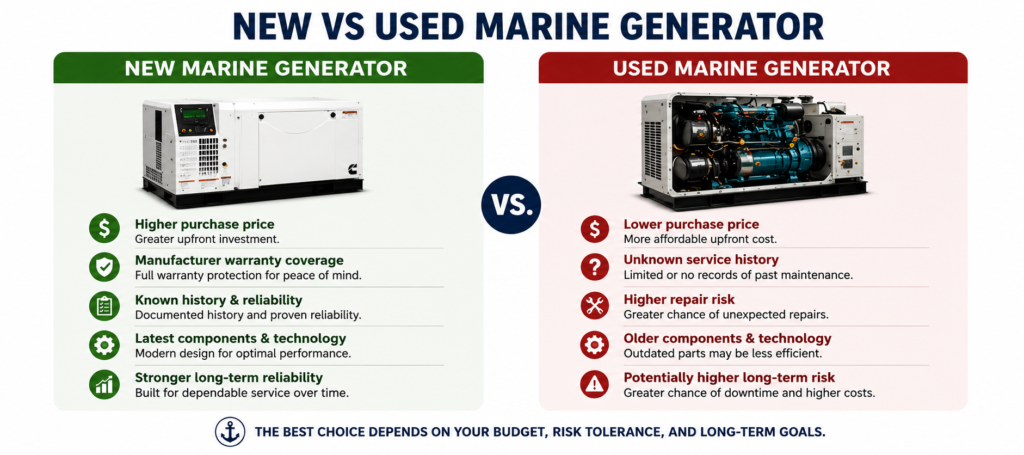
New vs Used Marine Generator Cost
Used generators can look incredibly attractive.
Sometimes they are.
Sometimes they are expensive problems disguised as bargains.
How Much Does a Used Marine Generator Cost?
There is no trustworthy universal range because price depends heavily on:
Brand
Model
Age
Hours
Service history
Corrosion
Completeness
Condition
Whether controls/enclosure are included
Why Used Generators Look Attractive
The purchase price can be substantially below new replacement cost.
That can make sense when budget is constrained or an exact legacy replacement is needed.
Costs Buyers Often Miss
A cheap used generator can still need:
Heat-exchanger work
Raw-water pump
Injectors
Starter
Controller
Generator-end repair
Mounts
Exhaust components
Sound enclosure repairs
What to Inspect Before Buying Used
Ideally verify:
Model and serial number
Operating hours
Service history
Oil condition
Cooling-system condition
Corrosion
Stable voltage/frequency
Full-load operation
Leakage
Smoke
Controls
Included accessories
When Used Can Make Financial Sense
A documented low-hour generator that has been properly inspected and load-tested may make sense.
An unknown generator removed from a vessel with no test history should be priced as a risk.
marine generator purchase price versus total installed cost
New vs Rebuilt or Remanufactured Marine Generators
Do not treat used, rebuilt, and remanufactured as interchangeable words.
A used generator may have received little more than cleaning.
A rebuilt engine or genset has had some worn components repaired or replaced.
A remanufactured product should be understood according to the actual remanufacturer’s stated process and specification.
Warranty Differences
New units typically come with the applicable manufacturer warranty.
Rebuilt or remanufactured units may carry a different warranty supplied by the rebuilder.
Parts Availability
A perfectly rebuilt discontinued generator can still become expensive if critical control or alternator parts are no longer supported.
When Rebuilding Makes Sense
A rebuild can be attractive when:
Existing installation fits perfectly
Core components remain supportable
Structural modifications for a new model would be expensive
A competent rebuilder can document the work
What Does It Cost to Replace an Existing Marine Generator?
The marine generator replacement cost has several layers.
Generator Price
This is the obvious one.
Removal of the Existing Genset
Consider disconnection, lifting and physical removal.
New Mounting & Foundation Work
The new generator may not share the old mounting footprint.
Electrical Conversion
Changing voltage, frequency or phase can turn a simple generator swap into an electrical-system project.
Exhaust & Cooling Changes
Outlet diameter, hose routing and seawater connections can differ.
Control-System Conversion
New digital controls may require new harnesses, panels or network interfaces.
Why Same kW Does Not Mean Same Installation Cost
Cummins’ published data makes this easy to understand. Its 4/5kW generator is roughly 676 mm long, while its 9.5–13.5kW housed family is about 1,047 mm long and substantially heavier. Even within similar output categories, configuration can change dimensions.
So replacing an old 10kW generator with a new “10kW-class” unit is not automatically a drop-in project.
Does a Larger Generator Cost More to Own?
Often, yes—but not simply because it has more kW.
Fuel Consumption
Fuel use depends on:
Generator size
Load
Engine
Operating speed
Duty profile
Use the fuel-consumption chart for the exact model rather than relying on a generic “gallons per hour per kW” rule.
Oil & Filters
Larger engines generally hold more oil and may use larger or more numerous service components.
Impellers, Belts & Anodes
Maintenance schedules and costs vary by manufacturer.
Major Scheduled Maintenance
High-hour generators will eventually require more significant service.
Parts Availability
A common service part that can arrive tomorrow is economically different from a specialist component with a long lead time.
Technician Access
Poor installation access increases labor time every time the generator is serviced.
Commercial Downtime
For a working vessel, lifecycle cost should include lost operating time.
The Price-per-kW Trap
Here is one of the most useful contrarian lessons in this entire guide:
Marine generators are not commodities priced at a fixed dollar amount per kilowatt.
Look at current Phasor pricing.
Its 6.5kW compact generator is listed at about $10,175.
Its 14kW compact model is about $15,190.
The 14kW generator provides more than twice the output, yet its advertised purchase price is nowhere near double.
Why?
Because even a small generator still needs:
Diesel engine
Generator end
Control system
Cooling
Fuel system
Mounts
Safety shutdowns
Marinization
Manufacturing
Warranty support
Those fixed system costs do not disappear simply because output is 5kW instead of 10kW.
Cost per kW vs Value per Operating Hour
For a commercial operator, a more useful metric may be:
What does this system cost over the operating hours I expect to use it?
What You’re Really Buying
You are buying:
Reliable onboard power
Installation fit
Noise control
Serviceability
Parts support
Warranty
Expected useful service
That is much more meaningful than chasing the lowest $/kW number.
Cheapest Marine Generator vs Best-Value Marine Generator
These are not always the same machine.
Initial Purchase Price
Yes, compare it.
But keep going.
Installation Compatibility
A generator that saves $2,000 but requires $5,000 of additional vessel modification is not the cheaper project.
Maintenance Cost
Service access matters.
Parts Support
Availability matters.
Warranty
Coverage matters.
Resale & Replacement Support
Established product families can have advantages when future parts and replacement decisions arrive.
The least expensive marine generator to buy can become one of the most expensive to own if it requires extensive installation changes or becomes difficult to service.
How to Compare Marine Generator Quotes Correctly
Put two quotes side by side and check each line.
Exact Generator Model
Do not compare “8kW generator” with “8kW generator.”
Compare exact model numbers.
kW / kVA
Confirm the actual rating.
Voltage
120V? 120/240V? 230V? 400V?
Frequency
50Hz or 60Hz?
Phase
Single or three phase?
Sound Shield Included?
This can change the price significantly.
Remote Panel Included?
Check.
Harness Included?
And how long?
Mounts Included?
Do not assume.
Exhaust Components Included?
Mixing elbow, muffler, separator or siphon break may be separate.
Freight Included?
Beta explicitly lists shipping separately on its generator products. (Beta Marine USA Parts)
Taxes / Duties Included?
Particularly important for international orders.
Manufacturer Warranty
Verify the warranty for the exact model and intended recreational or commercial application.
Lead Time
A lower quote on a generator that cannot arrive for six months may have little value if the vessel must launch next month.
How Much Should You Budget for a Complete Marine Generator Project?
Think in three layers.
1. Generator-Only Budget
Use current public pricing to establish the basic equipment level.
For small and mid-size diesel marine generators, that frequently means roughly $8,500 to nearly $30,000 in the current examples reviewed here, depending on size and model.
2. Generator + Required Accessories
Add:
Sound enclosure
Remote controls
Harness
Mounts
Exhaust components
Cooling accessories
Service kit
3. Fully Installed Project Budget
Now add:
Freight
Removal
Crane/hoist
Structural modifications
Mechanical labor
Electrical labor
Exhaust/cooling/fuel modifications
Commissioning
The only responsible way to establish that final number is from the actual vessel.
Marine Generator Cost by Vessel Type
Sailboat Generator Cost
Sailboats often focus on compact 3kW–8kW marine generators, where space, weight and sound attenuation can have a significant effect on both generator and installation cost.
Cruising Boat Generator Cost
A cruising boat may land in the 5kW–10kW generator range, especially where refrigeration, charging and air conditioning operate regularly.
Yacht Generator Cost
Larger yachts can quickly move into 8kW–20kW+ marine generator territory as HVAC, galley and hotel loads increase.
Sportfishing Boat Generator Cost
Sportfishing boats may require significant HVAC, refrigeration, pumps and electrical loads, making 8kW, 10kW, 15kW and larger systems common comparison categories.
Liveaboard Generator Cost
A liveaboard should evaluate not only purchase price but:
Noise
Fuel
Maintenance
Daily operating hours
Service access
Commercial Marine Generator Cost
Commercial generator projects should place high value on:
Duty rating
Parts support
Three-phase capability
Motor starting
Cooling
Maintenance access
Downtime
A low initial price matters far less if the generator cannot support the vessel’s mission.
How to Reduce Marine Generator Cost Without Buying the Wrong Generator
Saving money is good.
Buying the wrong generator cheaply is not.
Size the Generator Correctly
Do not pay for 20kW if your vessel genuinely needs 10kW.
And do not buy 5kW to save money if the electrical load needs 8kW.
Avoid Paying for Capacity You Don’t Need
Appropriate headroom is good.
Extreme oversizing is not automatically value.
Compare Complete Packages
A generator that appears $1,500 more expensive may already include $2,000 worth of accessories missing from the cheaper quote.
Determine Sound-Shield Requirements Before Buying
Do not purchase an open generator because it looks cheaper and discover later that noise makes the installation unacceptable.
Reuse Compatible Vessel Infrastructure Where Appropriate
An existing exhaust, foundation or cooling arrangement may reduce replacement cost—but only when it is suitable for the new generator and remains in proper condition.
Plan the Installation Before Ordering
Measurements made before purchase are much cheaper than fabrication changes made after delivery.
That information allows a meaningful like-for-like price comparison.
So, How Much Should You Expect to Spend on a Marine Generator?
Here is the clearest answer.
Current public U.S. listings reviewed in August 2026 show new compact and mid-size marine diesel generators starting around the high-$8,000 range and reaching roughly $29,000 for some 20–30kW models, before installation and other project costs. Larger commercial and yacht generators are increasingly configuration-specific and can cost substantially more.
But do not build your budget around kW alone.
Use the Marine Generators Depot T.R.U.E. COST Framework:
Ticket Price
Required Configuration
Upfit & Installation
Expense to Deliver
Commissioning
Ownership & Maintenance
Support & Warranty = Total Lifecycle Value
That is the number worth comparing.
FAQs About Marine Generator Cost
How much does a marine generator cost?
Current public U.S. dealer listings show new compact marine generators starting around $8,500, while many mid-size diesel yacht generators fall into the $10,000–$20,000+ range. Current 20–30kW examples can reach roughly $17,000–$29,000 before installation. Exact cost depends on brand, output and configuration. (Bob and Annie’s)
How much does a 5kW marine generator cost?
Current examples put new 5kW-class marine generator prices around roughly $10,000–$11,000 before installation, although exact pricing depends on manufacturer and package contents. A current Cummins Onan 5kW listing is $10,693, while a Beta/NextGen 5.5kW model is listed at $10,350.
How much does an 8kW marine generator cost?
Current public examples around the 6–8kW class range from roughly $10,000 to more than $13,000 depending on brand and configuration. Phasor lists an 8kW compact model at $11,020, while an Onan 7.5kW model is listed at $13,230. (Bob and Annie’s)
How much does a 10kW marine generator cost?
Buyers searching for a 10kW marine generator often encounter actual ratings around 9–12kW. Current examples range from about $11,320 for a Phasor 9.5kW to $17,069 for an Onan 11.5kW.
How much does it cost to install a marine generator?
There is no reliable universal installation price. Cost depends on whether the project is a new installation or replacement and whether the vessel requires structural, exhaust, cooling, fuel or electrical modifications. Installation should be quoted from the actual vessel configuration.
How much does it cost to replace a boat generator?
Replacement cost equals more than the generator price. Budget for removal, freight, mounting changes, exhaust/cooling work, electrical integration and commissioning where required. A near-direct replacement can cost significantly less to install than a generator requiring major vessel modifications.
Why are marine generators so expensive?
A marine generator combines a diesel or gasoline engine, generator end, marine cooling, exhaust integration, corrosion-resistant components, safety shutdowns, electrical controls, mounts and often acoustic treatment in a compact system designed for a harsh onboard environment.
Does a sound shield increase marine generator cost?
Yes. Current public examples show material differences. A 6kW Kohler/Rehlko listing is about $10,088 without the sound shield and $12,837 with it, while Beta’s 5.5kW enclosure currently adds about $1,250 to the listed price. (Marine Generators USA)
How much does a used marine generator cost?
There is no meaningful universal figure because used pricing depends heavily on hours, condition, age, brand, service history and completeness. A used generator should be evaluated on total repair risk rather than purchase price alone.
Is it cheaper to rebuild or replace a marine generator?
Sometimes. Rebuilding can make financial sense where the existing generator fits the vessel perfectly, core components remain supportable and replacement would require substantial installation changes. Replacement may be more sensible when parts support is poor or major systems are already worn.
Which marine generator brand is cheapest?
There is no consistently cheapest brand across every output and configuration. Current public prices show meaningful variation between manufacturers even at similar kW ratings. Compare exact model, enclosure, controls, frequency, phase and included accessories before deciding which is genuinely cheaper.
What is the best-value marine generator?
The best value is the generator that properly matches the vessel’s electrical requirement and installation while providing acceptable serviceability, parts support, warranty and lifecycle cost. Lowest purchase price alone does not determine value.
How much does a commercial marine generator cost?
Commercial-generator pricing becomes increasingly project-specific as output, three-phase requirements, cooling, controls and vessel duty change. Manufacturers such as Cummins and Northern Lights offer marine generator systems ranging well beyond 50kW, where a configuration-specific quotation is more appropriate than a generic retail price.
Compare Marine Generator Costs for Your Vessel
If you are comparing a 5kW marine generator, an 8kW yacht generator, a 10kW marine diesel generator, a 20kW boat generator, or a larger commercial genset, start by making sure the prices you are comparing describe the same thing.
Marine Generators Depot can help narrow the options using your:
Vessel type
Existing generator model
Required kW/kVA
Voltage
50Hz or 60Hz
Phase
Sound-enclosure requirement
Installation space
Intended recreational or commercial use
Delivery destination
For a replacement project, the existing generator nameplate and installation dimensions are particularly useful.
It is to find the generator whose purchase price, installation requirements, operating costs and long-term support make sense together.
Because the most important question is not only:
“How much does a marine generator cost?”
It is:
“What will the right marine generator cost to buy, install, operate and support on my vessel?”
That is the cost worth knowing.
Used vs New Marine Generator Comparison
Pricing & Technical Source Note
Pricing examples in this guide were checked against publicly available U.S. dealer listings from Bosch Marine, Marine Generators USA, Beta Marine USA and Bob & Annie’s Boatyard during August 2026. Product ranges and technical details were cross-checked against manufacturer information from Cummins, Fischer Panda, Northern Lights and Phasor, with marine-system context supported by current ABYC standards information. Prices, availability and configurations can change, so the applicable seller quotation and current manufacturer specification should always be confirmed before purchase.