Buying a marine generator looks simple until you actually start comparing models.
At first, the process sounds straightforward: determine how much electricity the boat needs, pick a generator with enough kW, and place the order.
Then the questions begin.
Do you need 120V or 120/240V? Should it be 50 Hz or 60 Hz? Single-phase or three-phase? Heat-exchanger cooled or keel cooled? Open or sound-shielded? Will it physically fit through the engine-room access? Does the quoted package include the control panel, mounts, exhaust elbow, remote display, or even the sound enclosure shown in the product photograph?
Those details are why a proper Marine Diesel Generator Buying Guide needs to go much further than simply telling you what size generator to buy.
At Marine Generators Depot, we look at a generator as part of the vessel’s complete onboard power system. The best marine diesel generator is not necessarily the biggest, most expensive, or most popular model. It is the generator whose electrical output, configuration, dimensions, cooling system, operating characteristics, and service requirements actually match the vessel.
Whether you are selecting a boat generator for a sailboat, comparing yacht generators, replacing an aging genset, or sourcing a commercial marine generator, this guide will walk you through the decisions that matter before you spend your money.
What Is a Marine Diesel Generator?
A marine generator is essentially a dedicated onboard power plant.
A diesel engine drives an alternator, and the alternator produces electricity for the vessel. Instead of relying entirely on shore power or the propulsion engine’s charging system, the generator can supply electrical power while the boat is underway, anchored, working offshore, or operating away from the marina.
That power may be used for air conditioning, refrigeration, lighting, battery chargers, pumps, water heaters, navigation electronics, galley appliances, entertainment systems, hydraulic equipment, and other onboard loads.
This is why a marine genset becomes so important on vessels with significant electrical demand. On a small day boat, a generator may be unnecessary. On a motor yacht with several air-conditioning units, refrigeration, watermakers, cooking appliances, and entertainment systems, it can be essential.
Commercial vessels may depend on the generator even more heavily. A workboat, fishing vessel, patrol craft, or passenger vessel may require electrical power for pumps, winches, electronics, refrigeration, communications, deck machinery, or hotel loads for long periods every day.
Why a marine generator is different from a normal generator
A proper marine generator is designed for installation and operation aboard a vessel.
That means manufacturers have to consider conditions that a normal land-based generator does not routinely face: saltwater exposure, high humidity, vibration, restricted ventilation, tight installation spaces, wet exhaust systems, seawater cooling, vessel movement, and continuous operation under varying loads.
This is one reason you should not treat a portable household generator as a substitute for a properly installed diesel generator for a boat.
The marine environment changes the game.
Start With the Vessel, Not the Generator
One of the easiest buying mistakes is starting with a generator model you like and then trying to make the boat accommodate it.
Reverse that thinking.
Start with the vessel.
What does the vessel need? What electrical system is already installed? How much space is available? Where will the generator be located? How will it be cooled? How will the exhaust be routed? What loads will run simultaneously?
A generator should be selected around those answers.
Imagine two customers both asking for a 9 kW generator.
One owns a 42-foot sailing catamaran operating mostly in warm climates with multiple air-conditioning units.
The other owns a commercial fishing vessel where the genset may operate for long hours powering pumps, refrigeration, lighting, and electronics.
Both may technically need around 9 kW of electrical output, but that does not automatically mean the same generator configuration is appropriate for both vessels.
The application matters.
What Size Marine Generator Do I Need?
This is probably the question we hear most often in one form or another:
What size marine generator do I need?
The answer begins with your electrical loads.
You need to understand how much electricity the vessel will realistically consume while the generator is operating.
Understanding marine generator kW
Kilowatts, or kW, represent real electrical power.
If the electrical loads operating on your vessel collectively require 7 kW, you need a generator capable of supplying that load without being constantly pushed beyond its rated capacity.
The mistake is assuming that simply adding up the nameplate wattages of everything onboard gives you the perfect generator size.
It gives you a starting point, but not necessarily the final answer.
You need to consider which devices operate simultaneously, which loads cycle on and off, and which electrical motors require additional power during startup.
Running load and starting load are not the same
Air-conditioning compressors, refrigeration compressors, pumps, and other electric motors can require significantly more power for a brief moment when starting than they require once running.
That is known as the starting or inrush load.
You might have a collection of appliances that only require 6 kW while running, but if several compressors try to start at the same time, the generator may experience a much larger temporary demand.
That is one reason marine generator sizing should consider both normal running loads and motor-starting characteristics.
Modern soft-start devices can sometimes reduce air-conditioning startup demand, but that does not eliminate the need to size the generator correctly.
Don’t automatically choose the biggest generator
It is tempting to think:
“If 10 kW is enough, 20 kW must be better.”
Not necessarily.
A diesel engine is generally happiest when operating under an appropriate load. Consistently running a generator at very light load can be undesirable, while oversizing also adds purchase cost, weight, physical size, and potentially higher operating expenses.
On the other hand, undersizing creates a different set of problems: overloads, breaker trips, difficulty starting larger motors, unstable performance, and an electrical system that constantly feels like it is working at its limit.
The goal is not “as large as possible.”
The goal is the correct marine generator size for the vessel’s realistic operating load.
kW vs. kVA: What Is the Difference?
When shopping for marine generators, you may see both kW and kVA ratings.
They are related, but they are not exactly the same.
kW represents real usable power. kVA represents apparent power, which takes power factor into account.
For many recreational boat owners, the important thing is not memorizing electrical engineering formulas. It is understanding that you should not compare a 10 kVA generator to a 10 kW generator and automatically assume they provide the same usable output.
If a manufacturer lists output primarily in kVA, check the rated kW and specified power factor as well.
For larger yachts and commercial vessels, where three-phase motors and complex electrical systems may be involved, the difference becomes even more important.
Confirm the Vessel Voltage Before Ordering
A generator can be the correct kW rating and still be completely wrong for the boat.
Voltage is one of the reasons.
Marine generators are available in several electrical configurations depending on the model and market.
You may encounter 120V, 120/240V, 230V, 400V, 440V, 480V, and other configurations.
A 120/240V marine generator commonly appears in North American recreational applications, while 230V and 400V systems are common in other markets and larger vessels.
This is especially important when buying internationally.
Do not assume you need a certain voltage simply because of the country where you are purchasing the generator. The relevant question is:
What electrical system is installed on the vessel?
If you are replacing an existing genset, photograph the old generator nameplate and check the vessel’s electrical panel or documentation before requesting a quotation.
50 Hz vs. 60 Hz Marine Generators
Frequency is another detail that buyers sometimes overlook.
Marine generators are commonly configured for either 50 Hz or 60 Hz electrical systems.
A 60 Hz marine generator is common in the United States and other 60 Hz markets. A 50 Hz marine generator is common across Europe and many other parts of the world.
But again, do not choose frequency based solely on the boat’s current location.
A vessel built for European specifications may still be operating in Florida. A U.S.-built yacht may be cruising internationally while retaining its original 60 Hz electrical system.
The generator needs to match the vessel.
Frequency affects motors, pumps, air-conditioning systems, appliances, and other onboard electrical equipment.
Ordering the wrong frequency is not a small mistake.
It can turn what looked like a good generator deal into an expensive electrical problem.
Single-Phase vs. Three-Phase Power
Smaller recreational vessels commonly use single-phase electrical systems.
Larger yachts and commercial vessels may use three-phase power, especially where the electrical loads include large motors, pumps, refrigeration systems, HVAC equipment, or machinery.
A single-phase marine generator and a three-phase generator of similar kW output are not interchangeable simply because their power ratings appear similar.
Before ordering, confirm what the vessel actually requires.
If you are uncertain, consult the vessel’s electrical drawings, main switchboard information, existing generator nameplate, or a qualified marine electrician.
Marine Generator Cooling Systems
Cooling is one of the most important installation considerations.
Diesel engines create heat, and that heat has to go somewhere.
Heat-exchanger cooled marine generators
Many recreational marine generators use a closed freshwater cooling circuit within the engine, combined with raw seawater passing through a heat exchanger.
The seawater absorbs heat and is typically discharged through the exhaust system.
This is a very common configuration for yacht generators and boat generators.
The important thing to understand is that the installation needs the correct seawater intake, strainer, hoses, anti-siphon protection where required, exhaust routing, and proper water flow.
Keel-cooled marine generators
A keel-cooled marine generator uses an external cooling arrangement that transfers engine heat through a cooler mounted outside or integrated into the vessel’s hull system.
Keel cooling is particularly common in some commercial vessels, workboats, shallow-water vessels, and applications where raw-water intake systems may be undesirable.
If you are replacing a keel-cooled generator, you should not automatically assume a standard heat-exchanger model is a direct replacement.
That change can affect the entire cooling installation.
Open or Sound-Shielded Marine Generator?
Noise matters onboard a vessel.
A generator that seems reasonably quiet in a warehouse can feel very different when mounted a few feet from a cabin.
That is why many quiet marine generators for yachts are offered with sound enclosures.
Open generator sets
Open gensets can provide easier access for maintenance and may cost less than sound-shielded versions.
They can make sense when the generator is installed in a properly insulated machinery space or in applications where sound levels are not the primary concern.
Sound-shielded generators
Sound enclosures are popular on yachts, charter boats, sailing vessels, and other applications where passenger comfort matters.
The enclosure can significantly reduce mechanical noise, although overall onboard sound is also influenced by mounting, exhaust design, ventilation, insulation, and installation quality.
Do not assume a sound shield makes every installation silent.
It is one part of the complete noise-control system.
1800 RPM vs. 3600 RPM Marine Generators
You’ll commonly encounter generators operating at different engine speeds.
In 60 Hz applications, many traditional heavier-duty generator sets operate around 1800 RPM, while smaller compact units may operate around 3600 RPM.
Neither is automatically “good” or “bad.”
An 1800 RPM marine diesel generator is often associated with larger, heavier-duty or long-running installations. Lower operating speed can be attractive for applications where durability and long service life are priorities.
Higher-speed generator designs can offer advantages in compact dimensions and weight, which matters greatly on smaller boats where every inch of engine-room space counts.
Compare the whole package rather than making RPM your only buying criterion.
Fuel Consumption Matters, but Read the Numbers Correctly
Fuel consumption is often marketed as a single attractive number.
Be careful.
Generator fuel use changes with electrical load.
A generator operating at 25% load will consume less fuel per hour than the same generator operating at full rated load.
That means two manufacturers’ fuel-consumption figures should only be compared when the operating loads and test conditions are similar.
When evaluating marine generator fuel consumption, look for manufacturer data at multiple load levels, such as 25%, 50%, 75%, and 100%.
Then think about how you will actually use the generator.
If your typical onboard demand is around 60% of generator capacity, that operating point matters far more than an impressive fuel number measured at 25% load.
Measure the Installation Space Before You Fall in Love With a Generator
This may sound obvious, but it causes more trouble than people expect.
A generator does not just have to fit where the old generator sits.
It has to get there.
Measure:
- Generator length
- Generator width
- Generator height
- Access hatch or doorway dimensions
- Service clearance around filters, belts, impellers, and panels
- Exhaust and hose routing space
- Lifting and removal access
A generator may physically fit on the mounting bed but be impossible to move through the engine-room entrance without dismantling major vessel components.
This is particularly important when comparing replacement marine generators for older boats.
Modern replacement models may have different proportions even when their electrical output is very similar.
Check Generator Weight
Weight matters on boats.
It affects vessel balance, mounting requirements, lifting procedures, and installation logistics.
If a replacement generator is significantly heavier than the original, the installer should evaluate whether the existing generator bed and vessel structure are appropriate.
Similarly, changing to a much lighter unit may require new mounting arrangements.
Do not look at dimensions alone.
Check dry weight and, where relevant, operating weight.
Exhaust Configuration Is Not an Afterthought
Marine exhaust systems deserve serious attention.
Many recreational generators use wet exhaust systems where cooling water mixes with the exhaust gas.
Depending on the installation, components may include an exhaust mixing elbow, waterlift muffler, anti-siphon device, hoses, separators, and discharge fittings.
Incorrect exhaust design can create excessive backpressure or even allow seawater to enter the engine.
That is not something you want to learn after installation.
When planning a marine generator replacement, compare the existing exhaust location and configuration with the proposed new generator.
Follow the generator manufacturer’s installation requirements and have the final system reviewed by a qualified marine installer.
Controls and Remote Monitoring
Modern generators can offer much more than a simple start/stop switch.
Depending on the manufacturer and model, available controls may provide:
- Generator voltage
- Frequency
- Engine RPM
- Operating hours
- Battery voltage
- Coolant temperature
- Oil pressure
- Alarm history
- Remote start and stop
- Network integration
Some yacht owners want a remote display at the helm or electrical panel. Commercial operators may prioritize alarm monitoring and operating data.
When comparing marine generator packages, check whether the local control panel is standard and whether remote panels, harnesses, or monitoring modules are included or optional.
Do not assume the control shown in the brochure is automatically included in every package.
Parts Availability Should Influence Your Buying Decision
A generator is not a one-time purchase.
It will need servicing.
Filters will need changing. Impellers wear. Belts age. Sensors fail. Pumps eventually need attention.
Before buying, think beyond the generator itself.
Ask about availability of common marine generator parts, including filters, impellers, belts, anodes, gaskets, raw-water pump components, starter motors, sensors, control components, and maintenance kits.
This matters even more if you operate internationally.
A generator may look attractive on price, but if basic service parts are difficult to obtain in the regions where the vessel operates, that low purchase price can become much less attractive later.
Choosing the Right Marine Generator Brand
There is no single “best marine generator brand” for every boat.
That may not be the exciting answer, but it is the useful one.
The right brand depends on generator size, intended duty, physical constraints, service availability, budget, operating region, and customer priorities.
Marine Generators Depot works with a range of established marine generator categories, including Kohler Marine Generators, Cummins Onan Marine Generators, Fischer Panda Marine Generators, Northern Lights Marine Generators, Westerbeke Marine Generators, Mase Marine Generators, Nanni Marine Generators, Paguro Marine Generators, Phasor Marine Generators, Vetus Marine Generators, Lombardini Marine Generators, Next Gen Marine Generators, MasPower Marine Generators, MER Commercial Marine Generators, and Thornycroft Marine Generators.
A compact sailing yacht may prioritize low weight and minimal engine-room footprint.
A larger motor yacht may prioritize low noise and integration with onboard monitoring.
A commercial vessel may prioritize long operating hours, simple service access, and parts availability.
Brand selection should follow the application, not the other way around.
New vs. Used Marine Diesel Generators
Buying new has clear advantages.
You know the generator’s operating history. You typically receive applicable manufacturer warranty coverage. Documentation is generally easier to obtain, and current models usually have better parts support.
However, used and rebuilt generator sets can make sense in certain situations, especially where budget, availability, or a specific replacement footprint matters.
If considering a used unit, ask for operating hours, service history, serial number, load-test information, and clear photographs.
Inspect for corrosion, cooling-system condition, oil or fuel leakage, wiring modifications, and alternator condition.
A generator that looks clean after repainting may still have serious internal issues.
Price should never substitute for inspection.
Replacing an Existing Marine Generator
Replacement projects deserve their own approach.
The safest starting point is the existing generator nameplate.
Take a clear photograph.
You want to capture the manufacturer, model, serial number, output rating, voltage, frequency, phase, and RPM.
Then document the installation.
Measure the current generator.
Photograph the mounting feet, exhaust outlet, seawater connections, control system, engine-room access, and surrounding clearance.
This gives your supplier and installer something concrete to work from.
When customers contact Marine Generators Depot for a marine generator replacement, the more accurate information they provide at the beginning, the easier it becomes to narrow down suitable options.
Do not assume a newer model from the same manufacturer will have exactly the same footprint or connection locations.
Models evolve.
What Should a Marine Generator Quotation Include?
A professional quotation should tell you exactly what you are buying.
That sounds basic, but it matters.
The quotation should clearly identify the manufacturer, exact model, rated output, voltage, frequency, phase, and relevant configuration.
It should also state what is included.
Is the sound shield included?
What about the control panel?
Flexible mounts?
Exhaust elbow?
Remote display?
Wiring harness?
Fuel filter?
Service kit?
Your quotation should also identify significant exclusions, availability, estimated lead time, delivery arrangements, and applicable warranty information.
A cheap quotation can become expensive very quickly if several required components were never included.
Think About Installation Cost Before Comparing Generator Prices
The generator itself may only be one part of the project cost.
A replacement may require removal of the existing unit, modifications to the mounting bed, electrical rewiring, new exhaust components, plumbing changes, control wiring, sound insulation, lifting, commissioning, or even structural modifications to gain engine-room access.
This is why the lowest-priced generator is not automatically the lowest-cost project.
Sometimes a slightly more expensive generator that better matches the existing installation can save substantial labor and modification expense.
That is the kind of comparison worth making before the order is placed.
Common Marine Generator Buying Mistakes
Most expensive generator problems start with simple assumptions.
Customers often focus only on kW and overlook voltage, frequency, phase, or physical dimensions. Others assume the sound shield, controls, or installation accessories shown in a product image are part of the standard package.
Another common mistake is buying before checking service access.
You should be able to reach normal maintenance items after installation. Saving two inches of engine-room space is not much of a victory if changing the oil filter later requires dismantling half the enclosure.
And perhaps the biggest mistake is treating the generator as an isolated machine.
It isn’t.
It becomes part of the vessel’s electrical, cooling, fuel, exhaust, ventilation, and control systems.
Everything has to work together.
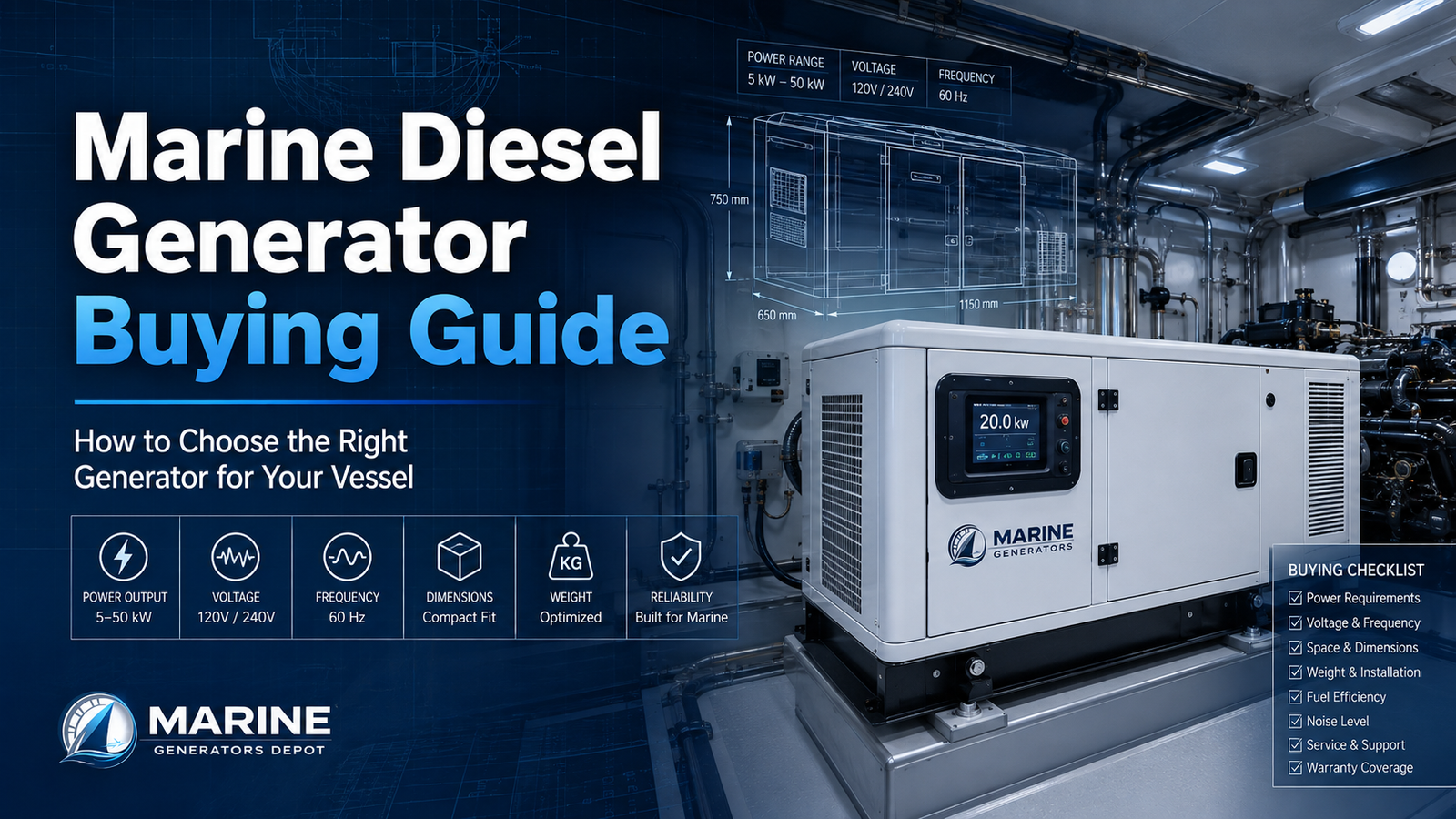
Marine Diesel Generator Buyer’s Checklist
Before requesting a quotation for a marine generator for sale, gather as much of the following information as possible:
- Vessel make, model, length, and application
- Recreational or commercial operation
- Required kW or kVA
- Voltage
- 50 Hz or 60 Hz
- Single-phase or three-phase
- Existing generator manufacturer and model
- Existing generator serial number
- Cooling configuration
- Maximum available installation dimensions
- Existing exhaust arrangement
- Sound enclosure requirement
- Required controls and accessories
- Delivery destination
- Required delivery date
For replacement projects, photographs of the existing generator and identification plate can be extremely valuable.
How Marine Generators Depot Helps
Marine Generators Depot is built around helping customers source generators and related components for recreational and commercial marine applications.
Our role is not to tell every customer that the same generator is “the best.”
Instead, we work from the information available for the vessel and project.
That may include required output, voltage, frequency, phase, cooling arrangement, installation dimensions, existing generator information, intended duty, and delivery destination.
From there, customers can compare available options from the generator brands we supply.
We also support enquiries for marine generator parts and accessories, replacement components, service items, and installation-related products for supported generator models.
Where vessel-specific engineering or installation approval is required, final suitability should be confirmed by a qualified marine technician, electrician, or installer.
Frequently Asked Questions About Marine Diesel Generators
What size marine generator do I need?
The correct generator size depends on the vessel’s expected simultaneous electrical load, motor-starting requirements, and desired operating margin. Create a realistic load calculation rather than simply adding every electrical device onboard.
Can a marine generator be too big?
Yes. Excessive oversizing can increase purchase cost, size, weight, and long periods of light-load operation. The aim should be an appropriately sized generator rather than the largest generator that fits the budget.
How many kW does a yacht generator need?
There is no universal answer. Smaller vessels may need only a few kilowatts, while large yachts can require tens or even hundreds of kilowatts depending on HVAC, galley systems, pumps, entertainment systems, and other hotel loads.
Should I choose 50 Hz or 60 Hz?
Choose the frequency that matches the vessel’s electrical system. Do not choose based solely on where the generator is purchased or where the vessel is currently located.
Is a sound shield worth it?
For many yachts, charter vessels, and recreational boats, yes. A sound enclosure can substantially reduce mechanical noise, but exhaust design, mounts, insulation, and installation quality also affect overall sound levels.
Can I replace my old generator with a different brand?
Often, yes. However, output, voltage, frequency, phase, cooling system, dimensions, mounting, exhaust, controls, and service access should all be compared before selecting a replacement.
Do marine generators include everything required for installation?
Not always. Package contents vary between manufacturers and models. Always check what is included and what is optional or excluded from the quotation.
Final Thoughts: Buy the Generator That Fits the Vessel
If there is one idea worth remembering from this Marine Diesel Generator Buying Guide, it is this:
Don’t buy a generator based on one number.
A 10 kW rating tells you something important, but it does not tell you whether the generator matches the vessel’s voltage, frequency, phase, cooling configuration, physical space, noise requirements, or operating profile.
The right generator is the one that fits the complete application.
That is particularly important with boat generators, yacht generators, and commercial marine systems because installation conditions vary dramatically from vessel to vessel.
Measure first.
Confirm the electrical configuration.
Understand your actual load.
Review the cooling and exhaust arrangement.
Check what is included in the package.
Think about parts availability five years from now, not just purchase price today.
And if you are replacing an existing generator, keep that nameplate photograph handy. It can answer more questions than a long email ever will.
Need Help Choosing a Marine Diesel Generator?
Marine Generators Depot can assist with new generator enquiries, replacement projects, parts, and accessories for recreational and commercial marine applications.
Send us your vessel details, required output, voltage, frequency, delivery destination, and any available installation information. If you are replacing an existing genset, include the generator model, serial number, and clear photographs of the identification plate.
Request a Marine Generator Quote →


Comments (2)
[…] marine diesel generator eventually needs routine […]
[…] first owner might reasonably end up comparing 5kW, 6kW or 8kW marine generators. The second may find that an 8kW, 10kW, 12kW or larger yacht generator better matches the actual […]