
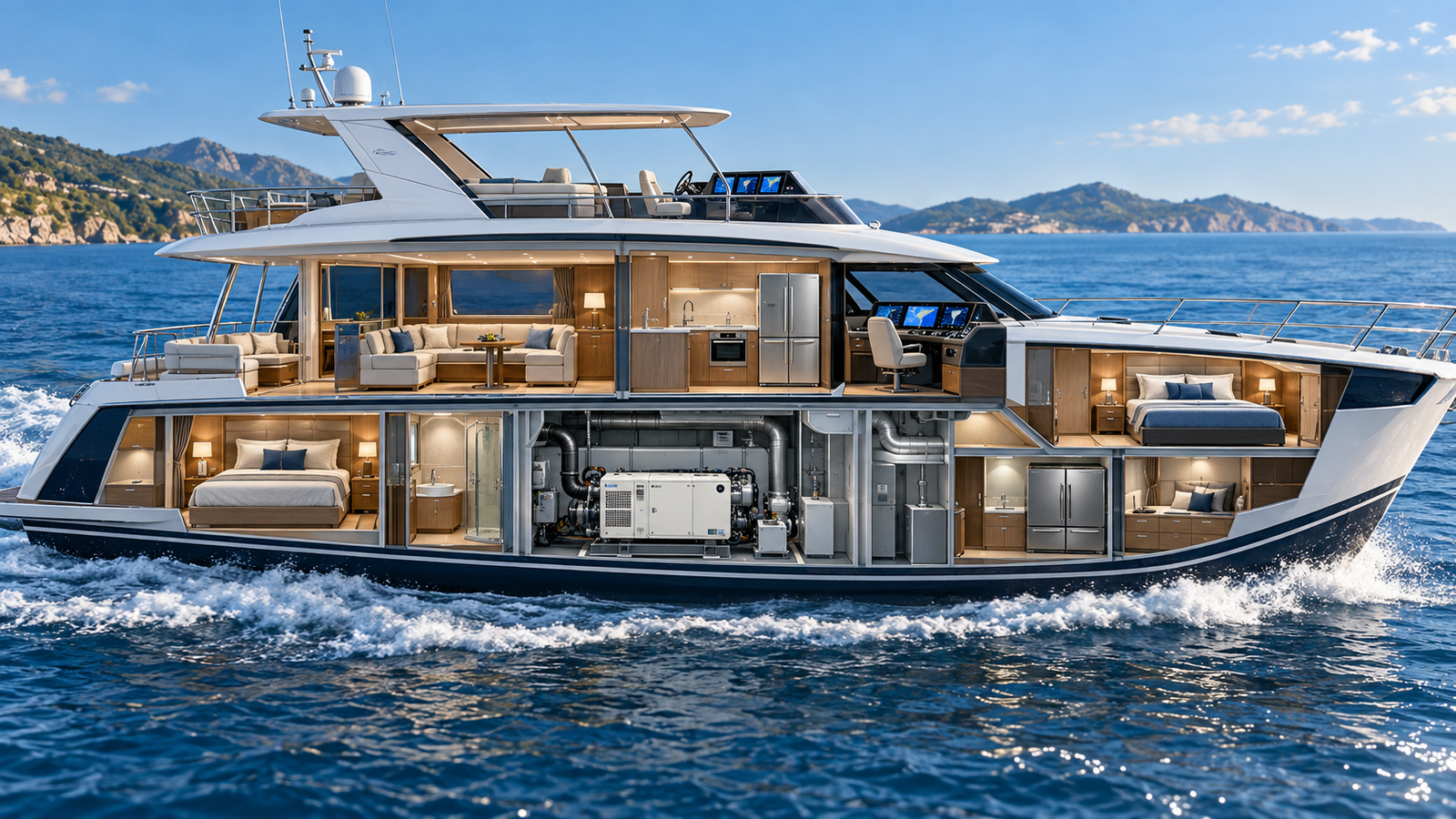
Consider a 48-foot cruising yacht spending a warm evening at anchor. The owner wants air conditioning, refrigeration, battery charging, and a watermaker—but also wants a generator that won’t dominate the cabin with noise. Two models may look similar on a product page, yet differ in output, electrical configuration, size, and sound enclosure.
This is an illustrative scenario, not a reported customer case. It points to the real decision: a yacht generator should match the yacht’s actual electrical needs, fit its machinery space, and be supportable where it cruises.
There is no single best generator for every 35–70 ft yacht. Choose by expected simultaneous loads, startup demand, voltage and frequency, installation space, noise priorities, and service access. Yacht length helps describe the vessel; it does not determine generator capacity.
The output bands below are comparison starting points only. They are not recommendations assigned to a specific yacht length. Marine Generator Depot’s catalog covers output classes from 3kW through 50kW and larger configurations, reflecting how widely vessel requirements can vary.
| Output band to compare | Use profile to investigate | Key checks |
|---|---|---|
| 5–8kW | Lower electrical demand or loads that can be scheduled selectively | Can it handle compressor startup and the appliances used together? |
| 9–13kW | A broader mix of comfort and service loads | Does the electrical configuration match the yacht? |
| 14–20kW and above | Higher demand or several substantial loads running together | Are the additional output, space, weight, and installation work justified? |
These bands help organize a shortlist. They do not mean that a 35-foot yacht needs one range or a 70-foot yacht needs another. A yacht with multiple air-conditioning units, watermakers, and galley equipment may have a different load profile from another vessel of the same length.
A marine generator for yacht use needs to fit into a vessel’s complete power system. The genset connects with onboard electrical equipment and must also fit into the machinery space alongside cooling, fuel, exhaust, ventilation, controls, and access for maintenance.
A yacht in this size range could be used for weekend trips, extended cruising, charter, or frequent operation at anchor. Those uses affect which electrical loads matter most and how long the generator may run.
Two yachts of similar length may have different air-conditioning zones, battery capacity, watermakers, cooking equipment, and cruising patterns. That is why a yacht diesel generator should be selected from the vessel’s equipment and use profile—not length alone.
“Hotel loads” means the equipment that supports comfort and daily use aboard. Depending on the yacht, that may include air conditioning, refrigeration, watermakers, battery chargers, pumps, galley appliances, lighting, and electronics.
List which items need to operate together. A generator that can support a battery charger and refrigeration may not also be suited to starting an air-conditioning compressor at the same time. Check equipment nameplates and manufacturer data before comparing capacity.
The generator has to fit through the access route and into the available compartment, with the required enclosure and connections. It also needs clearance for routine inspection and service. A unit that fits physically but blocks access to filters or other equipment can create avoidable maintenance problems.
Compare full installed dimensions and weight, not just the bare genset. Include the sound shield, mounting arrangement, control panel, and any required accessories in the space check.
A quiet yacht generator is not selected by its decibel rating alone. Sound levels are useful only when the measurement conditions are comparable, and the installed result also depends on the enclosure, mounting, exhaust, and machinery-space design.
Check the measurement distance and conditions used for each model. For example, a Fischer Panda 8000x manufacturer datasheet lists sound levels at three distances: 52 dB(A) at 7 metres, 62 dB(A) at 3 metres, and 67 dB(A) at 1 metre. A single number without its distance provides less useful comparison context.
When comparing a quiet marine generator, use manufacturer data for the exact model and configuration. Don’t treat ratings measured at different distances as directly comparable.
A sound shield can be part of noise control, but it is only one part of the installation. Also check mounting and vibration isolation, exhaust routing, operating speed, and where the generator sits in relation to cabins.
Ask what is included with the quoted model. Enclosures, remote panels, and other accessories may differ between configurations.
The generator’s location and installation affect the sound experienced aboard. A model with a low published rating may not deliver the same perceived quietness if it is installed near accommodation or if vibration and exhaust noise are not addressed.
For a fair shortlist, compare the model specifications first, then have the proposed installation assessed for the yacht. In Part 2, we’ll look at capacity and electrical configuration, then compare relevant generator brands and models.
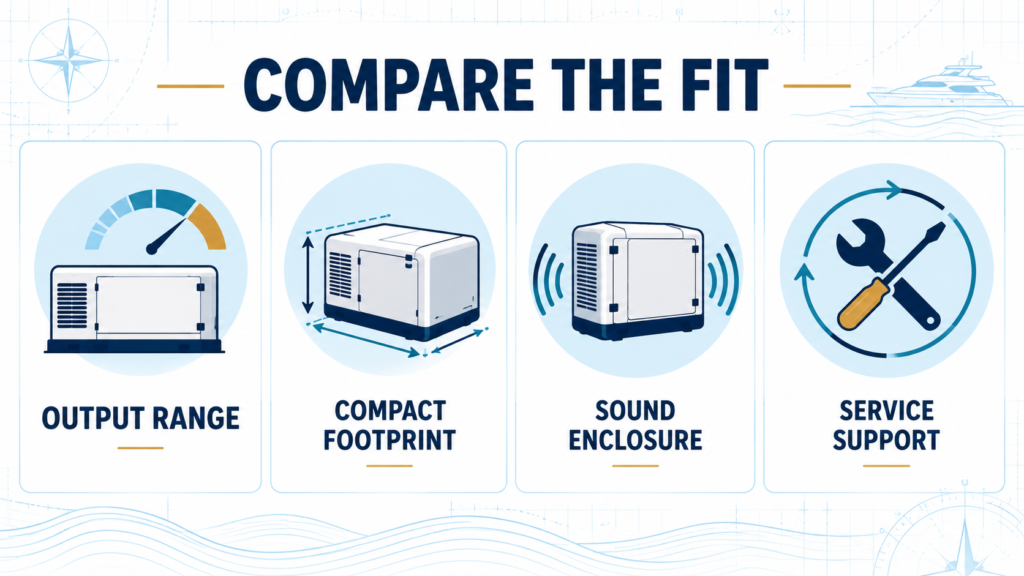
There is no single generator size for a yacht based on length alone. A 40-foot yacht with air conditioning, a watermaker, and a large battery charger may have different needs from a 60-foot yacht with fewer electrical loads.
Start by listing the equipment the generator must support: air conditioning, refrigeration, watermakers, battery chargers, pumps, galley equipment, and electronics. Then identify which items are likely to run at the same time.
This gives you a more useful picture than adding every appliance rating together without considering how the yacht is used. A qualified marine electrician or generator supplier can review the load list and help assess the suitable output.
Air-conditioning compressors and other motors may draw more current as they start than they do while running. For a marine generator for air conditioning, check both the units’ running requirements and their starting data. Also check how many compressors may start together and whether the system uses a soft starter or another load-management method.
Do not assume that a generator’s advertised output automatically supports every combination of onboard equipment.
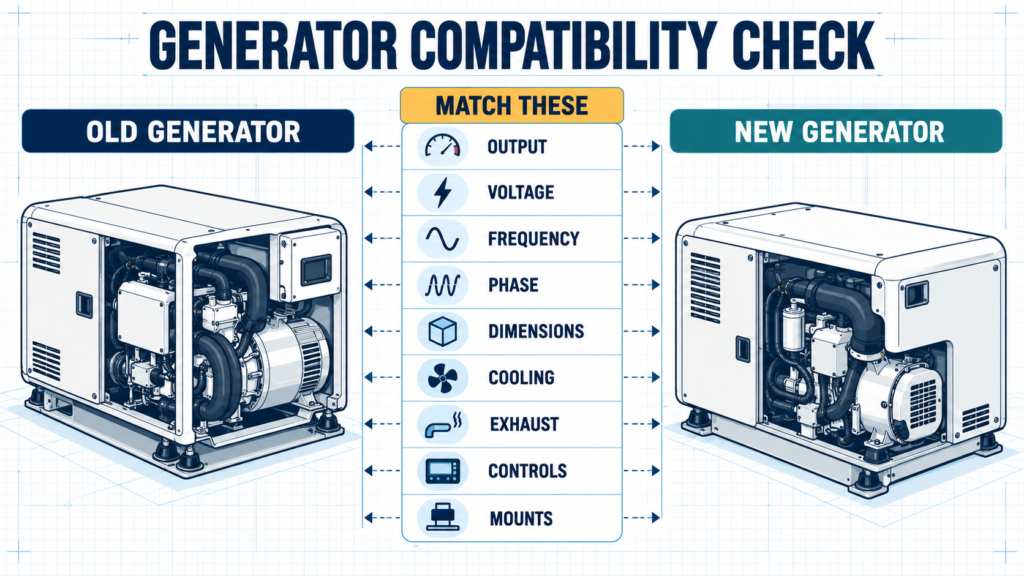
Before comparing models, confirm the yacht’s required voltage, frequency, phase, and AC or DC setup. Verify these against the generator datasheet and the requirements of the equipment aboard.
The difference between 50Hz vs 60Hz matters. A model family may include both configurations, but that does not mean each model has the same output or electrical specifications at both frequencies. marine diesel generator buying guide.
A generator’s product name may refer to kVA or a model class rather than its usable kW output. For example, Fischer Panda’s manufacturer datasheet for the Panda 8000x PMS lists 6.8kW and 8.0kVA for a 230V, 50Hz, single-phase configuration. Its model number alone is not enough to establish the delivered output.
Compare the rating, configuration, and datasheet for the exact model—not just the number in the product name.
Marine Generator Depot’s range includes brands such as Cummins Onan, Fischer Panda, Northern Lights, Kohler/Rehlko, Westerbeke, Paguro, Nanni, Mase, and Phasor. The shortlist should include models that match the yacht’s requirements and current availability, rather than treating any brand as a universal winner.
Cummins Onan Quiet Diesel models are available across a range of recreational marine output classes. Cummins’ current product page groups models by ranges including 4–5kW, 6–8kW, 7–9kW, and 9–13kW, with different frequency configurations. Compare the exact model code, voltage, frequency, output, dimensions, and installation requirements.
A Fischer Panda marine generator may be worth comparing when compact installation, sound enclosure, variable-speed operation, or DC battery charging is relevant. The brand offers different product families and electrical designs, so compare the specific model’s output type, operating range, voltage, frequency, sound data, dimensions, and weight.
For example, Fischer Panda’s 8000i PMS datasheet lists 6.4kW and 8.0kVA for its specified 50Hz configuration. This illustrates why model names and kVA figures should not be read as the same thing as continuous kW output.
When assessing Northern Lights or Kohler/Rehlko, compare a specific model’s output, electrical configuration, operating speed, enclosure options, installation footprint, warranty, and service access. Confirm current manufacturer data for the yacht’s region and system.
These brands may also fit a yacht project, depending on the required output and installation. Check whether the shortlisted model is intended for the yacht’s operating profile and whether parts and qualified service are accessible along its cruising route.
| Comparison item | What to verify |
|---|---|
| Output | Continuous and peak kW; kVA if listed |
| Electrical setup | Voltage, frequency, phase, AC or DC |
| Noise | Rating, measurement distance, and test configuration |
| Fit | Dimensions and weight, including enclosure |
| Installation | Cooling, fuel, exhaust, ventilation, and controls |
| Support | Warranty, parts availability, and service coverage |
| Quotation | Included accessories, freight, and any exclusions |
An AC yacht generator may suit a vessel designed to run substantial onboard AC equipment directly. Its voltage, frequency, and phase must match the yacht’s system and connected appliances.
A DC marine generator charges a battery bank. An inverter can then supply AC power to compatible equipment. This may suit an onboard system designed around energy storage, but the battery capacity, charging demand, and inverter limits all need to be considered.
Shore power, batteries, solar panels, and alternator charging may reduce how often a generator runs. Whether they can meet the yacht’s needs depends on power demand, cruising patterns, available space, weather, and charging time. They are best compared as part of the complete onboard energy plan.
A low published sound rating can help narrow the list, but it doesn’t tell you how quiet the generator will seem from a cabin after installation. Compare ratings on the same measurement basis, then assess the enclosure, mounts, exhaust, machinery-space location, and service access.
A quiet yacht generator is not necessarily the model with the lowest sound figure on a product page. Sound readings can depend on distance, load, enclosure, and test conditions. Installation also affects what owners hear and feel onboard. Marine-industry guidance treats space, access, load, cooling, and exhaust as important selection factors alongside noise.
Use this original five-part QUIET test to compare your shortlist. It’s a practical decision aid, not a published industry standard.
| Letter | Check | What to verify |
|---|---|---|
| Q | Quantify noise consistently | Compare sound figures at the same distance and under similar loads. Check the sound enclosure, vibration mounts, and exhaust arrangement too. |
| U | Understand how you use the yacht | List the loads you expect to run together, how often you’ll use the generator, and whether you need power underway, at anchor, or both. |
| I | Inspect the installation fit | Measure the machinery space and the route the unit must take to reach it. Include room to access service points after installation. |
| E | Evaluate electrical compatibility | Confirm output, voltage, frequency, phase, controls, and compatibility with the vessel’s existing electrical system. |
| T | Track support and lifetime cost | Check parts availability, dealer or technician coverage where you cruise, warranty terms, maintenance needs, and the full installed cost. |
Some mismatches are deal-breakers. First confirm that a candidate can meet the vessel’s actual electrical requirements, fit the available space, and work with the planned cooling, fuel, exhaust, and control arrangements. A strong noise rating or attractive purchase price cannot make up for an incompatible voltage or a unit that cannot be installed or serviced properly.
Once those basic requirements are met, compare the remaining options against your priorities. A cruising owner who values quiet nights at anchor may rank sound and battery-charging strategy highly. An owner who runs several air-conditioning systems may give more weight to load capacity, motor starting, and operating hours.
Ask each supplier how a published sound reading was measured: distance, operating load, and whether it describes the bare genset or a particular enclosure configuration. Then consider the whole installation. Rehlko, for example, describes its sound shield and air-management design as ways to reduce noise; that is a manufacturer claim about its equipment, not a guarantee of the sound level aboard every yacht.
A yacht generator installation involves more than setting a new unit on the old mounts. The replacement may differ in dimensions, weight, service access, cooling connections, exhaust routing, fuel connections, electrical output, or control wiring.
Record the old generator’s nameplate information and measure the unit, its mounting footprint, and clearance around service points. Then measure the route from the access opening to the installation space, including hatches, doors, turns, stairs, and overhead obstructions. A generator that fits inside the compartment may still be difficult to get through the boat.
Check whether the new unit’s weight or mount positions could affect the installation. Marine guidance recommends considering installation access and weight distribution when selecting a genset.
Have the installer check that the proposed unit can work with the vessel’s raw-water intake and discharge, fuel supply, ventilation, and exhaust arrangement. These systems must be assessed for the specific generator and vessel; existing hoses and fittings should not be assumed compatible just because the new genset is in a similar size class.
The manufacturer’s installation manual is the controlling reference for the model’s requirements. Ask the installer to identify any required changes before approving the order, including changes to the intake, strainer, exhaust components, or ventilation.
Confirm the generator’s output configuration against the vessel’s electrical system, including voltage, frequency, phase, transfer equipment, protection, and control-panel requirements. Ask whether existing remote controls, harnesses, alarms, or monitoring systems can be retained or need replacement. For a permanent AC genset, ask the qualified installer to confirm which applicable standards and requirements govern the work. ABYC lists A-27 for AC generator sets and A-24 for carbon-monoxide detectors and alarms.
Generator exhaust can expose people onboard to carbon monoxide. The U.S. Coast Guard advises boaters to maintain fresh-air circulation and know where engine and generator exhaust outlets are located. The CDC recommends installing and maintaining a carbon-monoxide detector listed for marine use. Include these checks in the replacement plan, especially if the exhaust route or machinery-space layout will change.
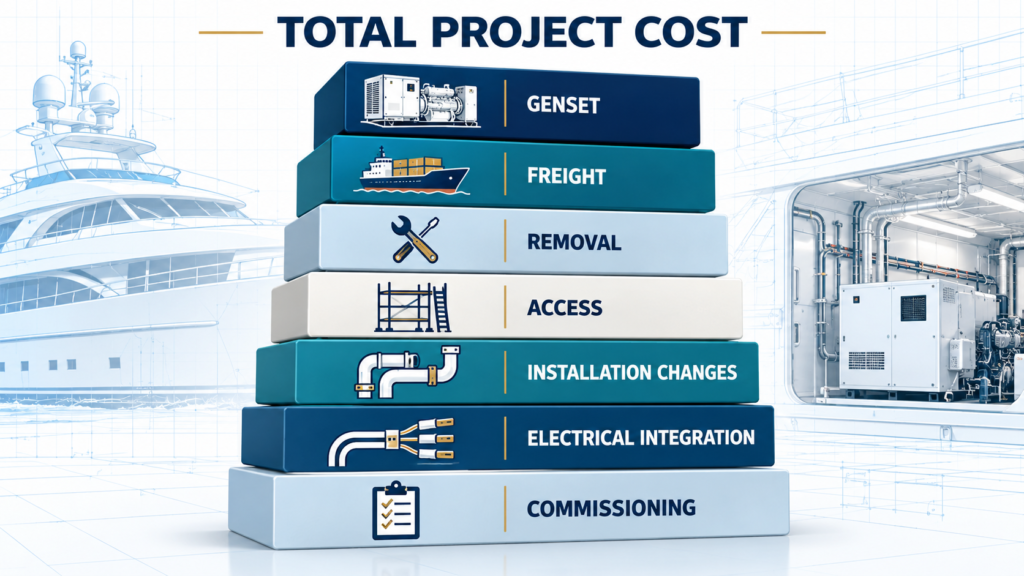
The yacht generator cost is more than the price of the genset. The total project may also include removal, freight, lifting or access work, installation changes, electrical integration, commissioning, and any parts or options required for the specific vessel.
| Cost item | What to clarify in the quote |
|---|---|
| Generator set | Exact model, output, voltage, frequency, phase, and included equipment |
| Removal and disposal | Whether removal of the old genset and disposal are included |
| Freight and handling | Delivery location, lifting arrangements, and any special access costs |
| Installation changes | Any required work on mounts, cooling, fuel, exhaust, ventilation, or wiring |
| Controls and accessories | Panels, harnesses, sound shield, transfer equipment, and other options |
| Commissioning | Startup checks, load testing, and documentation included in the job |
| Parts and support | Warranty coverage, routine service items, and parts availability |
Ask for an itemized, written scope so you can compare like with like. A lower equipment price may exclude work or components that appear in another supplier’s quote. Conversely, an installation estimate is not comparable until you know what the installer included and what remains the owner’s responsibility.
Prices and availability can change, and installation costs depend heavily on the vessel and location. Request a current quote for the exact model and project rather than treating a broad online price as a firm estimate.
The more vessel information you can provide, the easier it is to narrow down a suitable marine generator for yacht use and identify likely installation questions.
If the generator is being replaced, include the reason for replacement and note any changes planned to the yacht’s loads. That helps distinguish a like-for-like yacht generator replacement from a project that needs a new capacity or system configuration.
There is no single best model for every yacht in this length range. The right choice depends on simultaneous electrical loads, startup demands, voltage and frequency, available space, noise expectations, and service support in the cruising area. Manufacturer product ranges vary, so confirm the specifications for the exact model and configuration. Cummins, for example, lists marine generator output classes from 4–5 kW through larger ranges, while other manufacturers offer different product lineups.
Length alone is not enough to select generator capacity. A lightly equipped 50-foot yacht may have different electrical needs from a 40-foot yacht with multiple air-conditioning units, an electric galley, and a watermaker. Make a load list, identify which equipment will run together, and account for motor-starting demand before selecting a kW rating.
There is no universal answer unless models are compared under the same measurement conditions and installation setup. Compare sound readings at a stated distance and load, then check the sound enclosure, vibration mounts, operating speed, and exhaust system. The installed result can differ from a product-page figure.
Often, but a different brand or model may require changes to mounting, connections, controls, cooling, exhaust, or electrical integration. Check the exact specifications and installation requirements before ordering; don’t assume the new unit is a drop-in replacement because the rated output is similar.
No. kW measures real power; kVA measures apparent power. The relationship depends in part on power factor, so compare the generator’s published ratings with the vessel’s electrical requirements rather than treating the numbers as interchangeable.
Choose a generator configuration that matches the vessel’s electrical system and intended use. Frequency affects equipment compatibility and can affect a generator’s output rating. If you plan to cruise in regions with different shore-power standards, discuss the complete onboard system with a qualified marine electrician before deciding.
They can reduce generator runtime, but whether they can replace a genset depends on energy use, battery capacity, charging sources, and the size and duration of onboard loads. YachtWorld describes hybrid systems combining generators with battery and inverter systems as an emerging option; evaluate the complete system for your actual usage before making a decision.
The genset itself is one part of the cost. Removal, delivery, access, installation changes, electrical integration, options, and commissioning can also affect the total. Request an itemized quote for your vessel and verify what is included.
The strongest generator choice is one that meets the yacht’s real power needs, fits the available space, matches the electrical system, can be installed safely, and has support where you cruise. Use the QUIET test to compare suitable candidates, then confirm the exact model and installation details against current manufacturer documentation.
For help narrowing down options, contact Marine Generator Depot with your yacht details, generator nameplate, load list, electrical configuration, compartment measurements, delivery location, and target timeline. That gives the team a practical starting point for discussing a replacement yacht generator that fits your vessel and project.
