
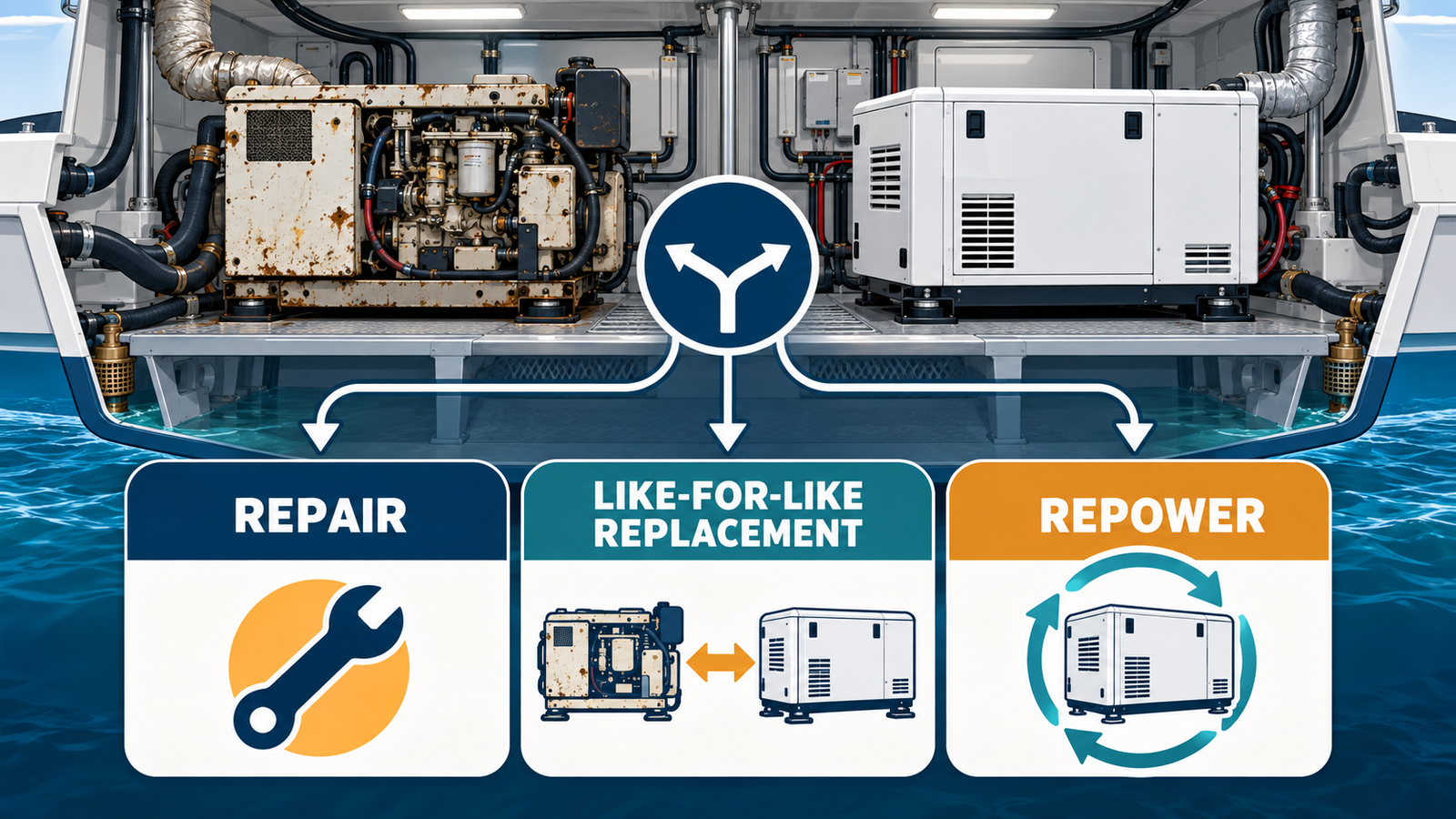
A boat’s electrical needs change over time. New equipment may be added during a refit, or an older genset may become unreliable just when the owner depends on onboard power.
A Power & Motor Yacht article about a boat’s generator project offers a useful example. As the vessel’s systems were being upgraded, a Northern Lights representative cautioned that owners can oversize a generator by assuming every onboard appliance will run at the same time. The lesson applies to replacement projects too: newer equipment does not automatically mean the vessel needs a larger generator.
That’s one reason a marine generator replacement needs more thought than matching the old unit’s kW rating. The owner must weigh repair, replacement, and repowering options against the vessel’s actual electrical needs and installation. This guide walks through that decision and the issues to check before requesting a quote. Marine diesel generator buying guide.
The right replacement marine generator must meet the vessel’s electrical requirements and suit its installation. It might be the same model, a current successor, or a different brand. The old generator’s kW rating is useful information, but it does not prove that another unit will fit or work with the vessel’s system.
Start by identifying the existing genset and the problem it has. Then check whether the vessel’s needs have changed, what parts and service are available, and what modifications a replacement could require. Marine Generator Depot’s replacement guidance also calls out electrical configuration, mounting dimensions, cooling, exhaust, and controls as factors to check.
In short, ask two questions: Can the existing generator be repaired sensibly? And if replacement is needed, which candidate best fits this vessel and its installation?
These options describe different scopes of work. Understanding the difference helps you compare recommendations and quotes.
| Option | What it means | What to review |
|---|---|---|
| Repair | Diagnose and fix the existing genset | The cause of the fault, parts availability, repair scope, and likely downtime |
| Like-for-like replacement | Replace the old unit with the same model or a current equivalent | The new unit’s specifications and whether its installation requirements match |
| Repower | Select a different current model, potentially from another brand | Compatibility, required installation changes, service support, and total project scope |
Repair may be worth investigating if a technician can identify a specific fault, the required parts are available, and the generator still suits the vessel. Ask for a diagnosis and a clear estimate of the proposed work. Repeated shutdowns or hard starting deserve investigation; either symptom alone is not proof that the whole generator needs replacing.
A similar model or manufacturer successor may be a candidate, but don’t assume it is interchangeable with the old unit. Confirm the exact model and configuration against current manufacturer documentation, including relevant electrical and installation details.
A marine generator repower means considering a broader range of current models, which may include a different brand. That can be useful if the old unit is discontinued or no longer suits the vessel. However, a change in model can require changes to the installation. Have a qualified marine technician or electrician assess final compatibility.
The points below are reasons to investigate your options. They are not a substitute for inspection, and they do not establish a universal replacement threshold.
If problems keep returning, ask what is causing them and what repairs are required. Compare a clearly scoped repair estimate with replacement options. If the cause is uncertain or the proposed work is extensive, a second opinion may help you make a more confident decision.
When a genset is discontinued, parts and service can become harder to find. Start with the exact manufacturer, model, and serial number; a clear photo of the identification plate can help. Some parts may have a superseding number, while others may no longer be available. Confirm availability and compatibility before ordering.
A refit may add equipment or change how the boat is used. Reassess the loads the generator needs to support; don’t automatically choose a higher-rated unit. As the Power & Motor Yacht example illustrates, sizing based on every appliance running at once can lead to oversizing. Have actual operating patterns and starting requirements reviewed as part of the selection process.
Noise, vibration, difficult access for maintenance, or planned work on the vessel may be reasons to compare different configurations. They are not guarantees that a new model will solve the issue. Review the generator and the vessel’s installation together.
There is no single age or hour count at which every marine generator should be replaced. Consider its condition, maintenance history, diagnosed faults, parts support, intended use, and repair scope. Marine Generator Depot’s replacement guidance similarly says to assess the generator’s overall condition rather than relying only on operating hours.
Those checks can help determine whether a boat generator replacement is worth considering. For a yacht generator replacement, also account for the unit’s space, access, and connections. Gather the relevant details before deciding which path to take.
Use this checklist to compare options before deciding on a marine diesel generator replacement. It is an editorial framework, not an official manufacturer standard or an engineering approval.
List the electrical equipment the generator must support and consider which loads are likely to run together. Include motor and compressor starting requirements in the load review. A Northern Lights representative quoted by Power & Motor Yacht warned that adding every onboard load together can lead owners to oversize a genset. A qualified marine professional can help assess the vessel’s actual requirements.
Compare the vessel’s required output, voltage, frequency, and phase with the proposed generator’s specifications. Check the specific model and configuration; don’t infer these details from the brand name or kW rating alone.
Check the compartment’s available space, mounting footprint, generator weight, maintenance clearance, and route for removing the old unit and bringing in the new one. Confirm measurements against the manufacturer’s documents for the precise configuration. Cummins notes that some product dimensions can vary by configuration.
Compare the existing installation with the proposed unit’s cooling, exhaust, fuel, controls, wiring, and mounting requirements. A difference in one of these areas may affect the work required; have the responsible technician review it before purchase.
Check parts availability, service options, warranty conditions, and support in the vessel’s operating region. Warranty and service details can vary by model and market, so verify them for the exact unit being considered.
Compare the equipment price with freight, removal, any installation changes, and commissioning. A lower-priced genset is not necessarily the lower-cost project if it requires significant work to fit the vessel.
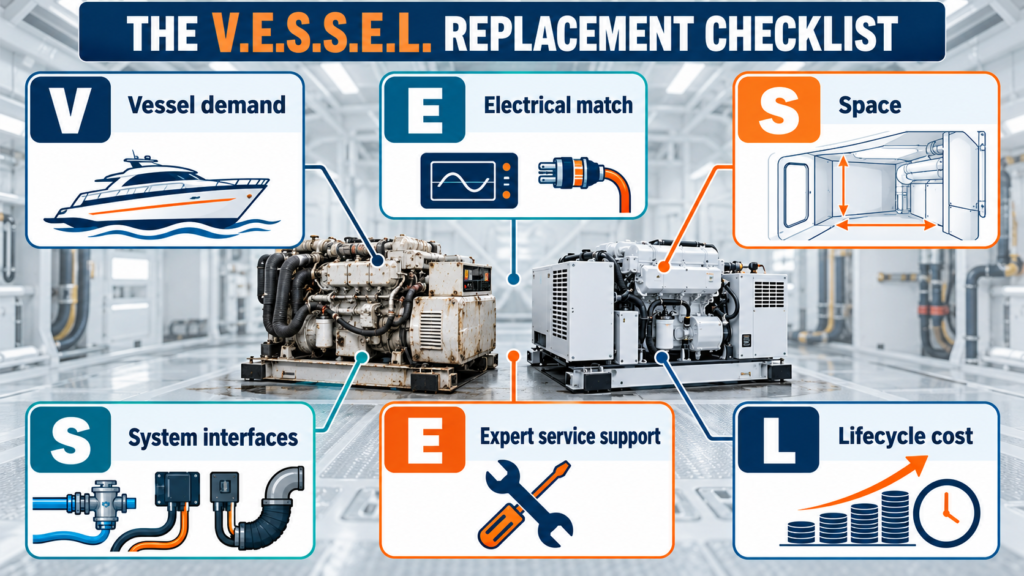
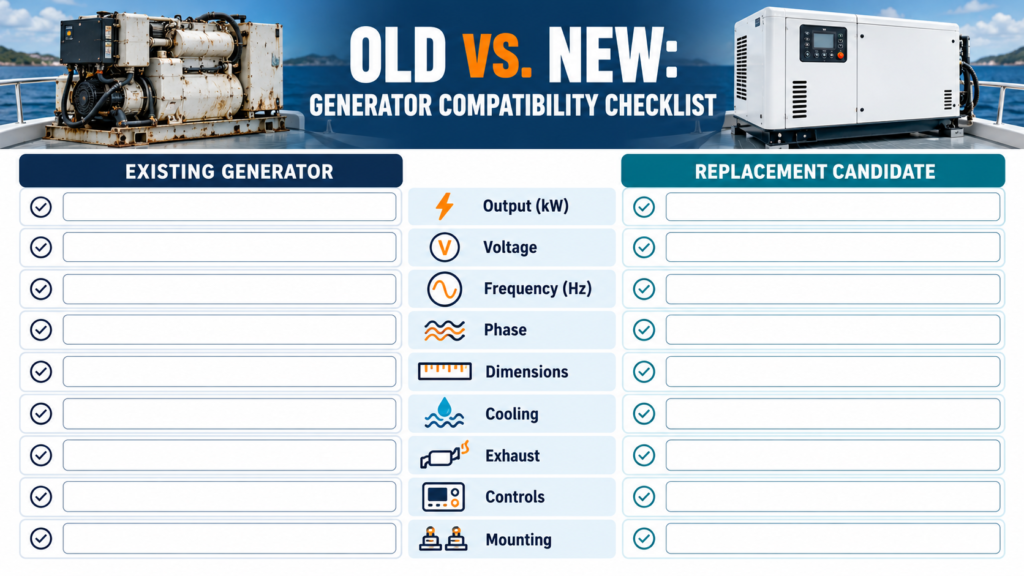
The more complete the comparison, the less likely an important specification will be missed. Marine Generator Depot’s replacement guidance similarly recommends reviewing details such as electrical configuration, dimensions, cooling, and exhaust before selecting a candidate.
Start with the old generator’s rated output, but don’t treat it as the complete specification. Review whether the vessel’s current loads and operating pattern still match that output. If the boat’s use or equipment has changed, reassess the requirement rather than automatically repeating the old rating or increasing it.
Confirm the generator’s voltage, 50 Hz or 60 Hz frequency, and single-phase or three-phase output against the vessel’s electrical system. A product may be available in multiple configurations; verify the exact model data and have a qualified marine electrician check the vessel requirements where needed.
Compare the new unit’s length, width, height, weight, and mounting arrangement with the existing installation. Also consider service access and the removal route. The genset may fit inside the compartment yet still be difficult to install or maintain if access is restricted.
Identify the current configuration and compare it with the proposed model’s documentation. Check cooling and exhaust arrangements, fuel connections, control-panel requirements, wiring, and any accessories the project needs. Don’t assume the existing panel or connections can be reused.
Check which parts and support apply to the exact model and your operating region. Don’t assume an older generator’s warranty or service arrangements carry over to a newer unit. Keep the applicable manufacturer documents with the quote for review.
Cummins’ manual calls for generator electrical connections and installation to follow the relevant instructions and applicable codes, with work handled by trained and experienced personnel. Northern Lights provides installation and technical manuals for its marine gensets.
A discontinued model doesn’t automatically mean that the whole project must use a particular brand—or that any similar-looking generator will fit. Compare viable routes against the V.E.S.S.E.L. checks.
First ask whether the original model remains available or has a current successor. Compare the exact specifications and configuration rather than relying on a similar model name. Confirm whether any existing components can be reused.
A marine generator cross-brand replacement may be worth comparing if the original model is unavailable or another option appears to suit the vessel. Review electrical output, system configuration, installation requirements, parts support, and warranty for each candidate. Marine Generator Depot lists a range of generator brands, but the article should present specific models as candidates only after their specifications are verified.
If replacement options require substantial modifications, compare them with a properly scoped repair or rebuild. For a used or remanufactured set, request its model and serial details, maintenance or rebuild records, included components, condition assessment, and written warranty. A low purchase price alone does not establish value, and suitability still needs to be checked for the vessel.
The goal of a marine genset replacement is not to find a universal “best” brand. It is to identify a suitable option for the vessel, then confirm that choice against current manufacturer documentation and the installation plan.
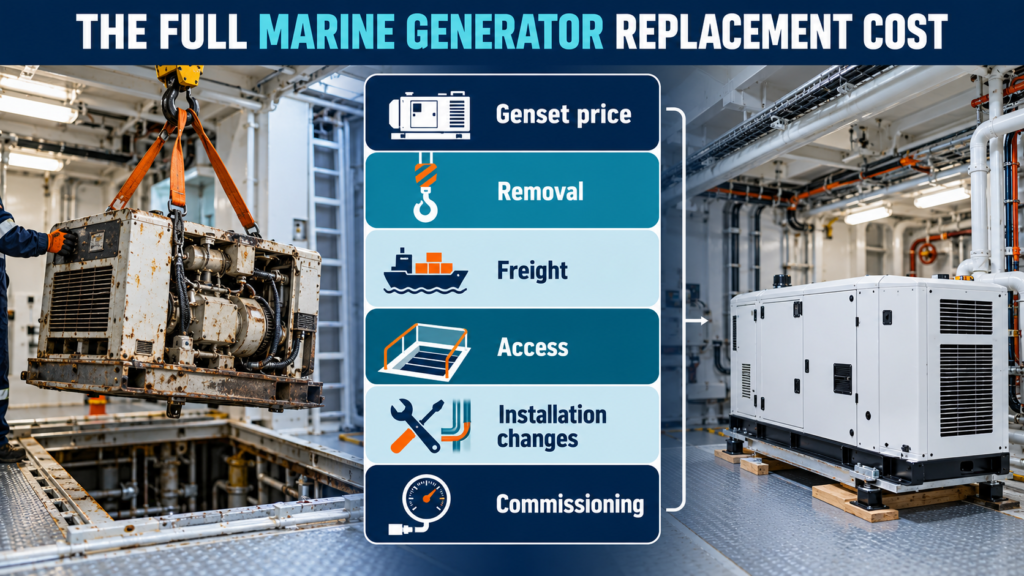
The marine generator replacement cost is more than the purchase price of the genset. The total project may include removing the old unit, delivery, installation, system changes, and commissioning. Which of those costs apply depends on the generator, the vessel, and the installation.
Not every replacement needs every item. Marine Generator Depot’s cost guide also distinguishes a close match to the existing installation from a broader repower, where changes to mounting, cooling, exhaust, electrical systems, or access can affect project cost.
When you request a marine generator replacement quote, check that you understand what is included and excluded. Compare the proposed model and configuration, control panel, sound enclosure, harnesses or accessories, freight, delivery arrangements, estimated availability, and warranty terms.
A quote that lists only the genset price may not describe the total project cost. For a wider discussion of prices and installation expenses, see Marine Generator Depot’s marine generator cost guide.
A planned marine genset replacement begins with information gathering and a technical review. These steps can help you prepare; they are not instructions for installing a generator yourself.
Ask a qualified marine technician to assess the fault and outline possible repair work. If repair is being considered, clarify which parts are required, whether they are available, and what the proposed work covers.
Photograph the identification plate and note the manufacturer, exact model, serial number, output, and known electrical configuration. These details can help identify the correct specifications and possible replacement options. Marine Generator Depot also recommends providing the nameplate, installation details, and vessel information for a replacement enquiry.
Describe the electrical equipment the generator is expected to supply and how the vessel is used. If equipment or operating patterns have changed, have the load requirements reviewed before selecting a replacement. Don’t assume the new set should automatically be larger than the old one.
Gather photos and measurements of the existing generator, mounting area, connections, and available access. Include relevant details about cooling, exhaust, fuel, and controls where known. The technician responsible for the project should confirm what can be reused and what may need to change.
Check the actual model and configuration—not just a brand name or approximate output. Use current manufacturer specifications, installation documents, and warranty information. Cummins’ manual says generator installation and electrical connections must follow the relevant instructions and applicable codes, with work handled by trained and experienced personnel.
Ask the supplier to identify the proposed model, configuration, inclusions, optional items, exclusions, availability, delivery arrangements, and applicable warranty. If technical details remain unknown, ask what must be confirmed before the selection is finalized.
Before ordering, have the vessel’s qualified marine technician or electrician review the proposed unit and project requirements. This helps identify compatibility questions before equipment is shipped.
A concise enquiry with clear identification and vessel details can help the supplier review suitable options. Include what you know; you do not have to guess at specifications you cannot confirm.
If the generator is already removed, photos of the former installation and its connections may still be useful. If a part number or specification is unclear, say so rather than guessing.
Possibly. A different brand may be a candidate if its specifications and installation requirements suit the vessel. Have the proposed model and its interfaces reviewed before treating it as a direct replacement.
Not necessarily. The old rating is a useful reference, but the vessel’s present electrical needs and the candidate unit’s configuration also matter. Have the load requirements reviewed rather than choosing solely by the nameplate’s kW figure.
Record the exact model and serial number, then ask about available parts, manufacturer successors, and other possible replacement models. A discontinued model does not by itself establish that replacement is the only option.
There is no reliable universal price. The total depends on the selected genset, delivery, removal, installation access, any system changes, and commissioning. Request a written quote that separates the equipment price from other project costs.
Only if compatibility is confirmed for the proposed model. Don’t assume existing controls, enclosure, wiring, or accessories will work with another unit. Check the model-specific documentation and installation plan.
Do not treat a replacement as a simple swap. Cummins’ manual directs that installation and electrical connections follow the applicable instructions and codes, with work handled by trained and experienced personnel. Consult the manufacturer documentation and the professional responsible for the vessel.
The timeframe depends on the project. Product availability, configuration, shipping, installation changes, access, and the technician or shipyard schedule can all affect it. Confirm the current estimate for the specific unit and delivery destination before planning around a date.
A good replacement decision starts with diagnosis, accurate identification, and a review of what the vessel actually needs. Compare repair, like-for-like replacement, and repower options. Then check electrical configuration, installation requirements, support, and total project scope. The best candidate is the one confirmed for the specific vessel—not simply a familiar brand or matching kW rating.
Marine Generator Depot helps customers compare marine generator options and replacement enquiries. To request a review, send your generator nameplate photo, vessel details, installation photos or measurements, and delivery destination. A qualified marine professional should confirm final compatibility and installation requirements before the unit is ordered.
