
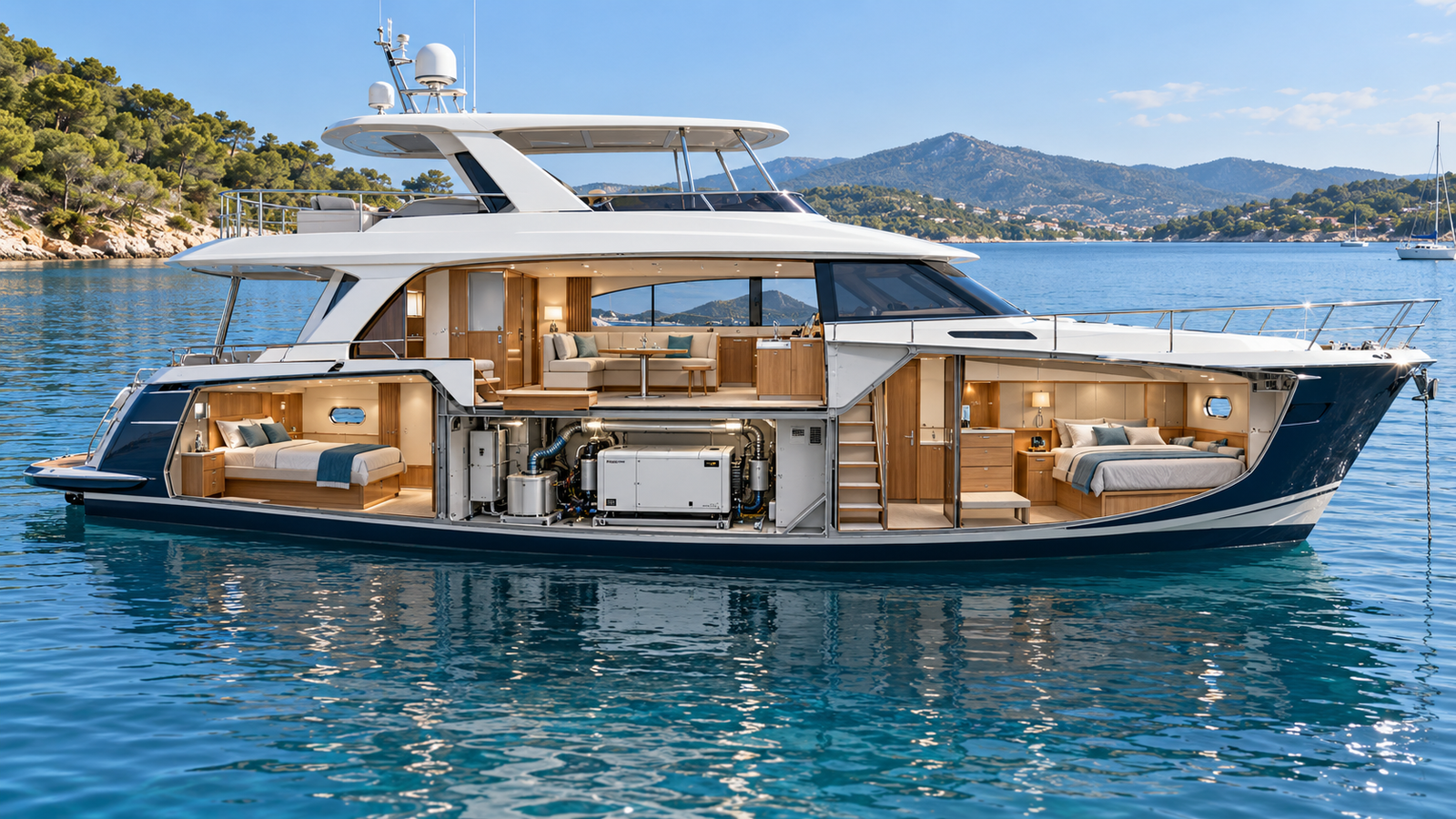
The opening scenario below is illustrative, not a documented customer case.
Picture a couple at anchor. Their new generator’s brochure promised low noise, but at night they still hear a steady vibration through the aft cabin. The issue may not be the generator’s sound rating alone. Sound can travel through the hull, mounts, exhaust, and machinery-space surfaces.
That is why “quietest” needs context. There is no single quiet marine generator that will be the quietest choice for every boat. Compare sound ratings under similar conditions, then consider how the generator will be installed and how it will sound where people actually spend time.
Quick answer: To compare quiet marine generators, check the stated dB(A) rating, measurement distance, operating conditions, sound enclosure, vibration control, exhaust arrangement, and service support. Then assess likely sound at the berth or living area—not only beside the generator.
A quiet boat generator is one that produces an acceptable level of noise and vibration for the vessel’s intended use and installation. That judgment calls for more than a single number on a specification sheet.
Manufacturers commonly express sound levels in dB(A), a measurement adjusted to reflect how the human ear responds to different frequencies. It gives buyers a useful comparison point when the measurement conditions are clear.
But a dB(A) figure is not a complete description of what you will hear onboard. A rating measured a few metres from a generator tells you about sound at that measurement position. It does not, by itself, tell you how much noise or vibration will reach a nearby berth.
Check the distance used for the rating. A reading at 7 metres and a reading at 1 metre aren’t directly comparable. Also look for the generator’s operating conditions: the load, speed, and whether the quoted rating includes a sound shield.
For example, Fischer Panda publishes a 52–54 dB(A) range at 7 metres for its iSeries. That is manufacturer-published information, not a side-by-side independent test of generators from different brands.
Use a comparison table to record the details alongside each noise figure:
| Comparison detail | Why it matters |
|---|---|
| dB(A) rating | The stated sound level |
| Measurement distance | Tells you where the level was measured |
| Operating load and speed | Gives context for the reading |
| Sound-shield configuration | Identifies whether an enclosure was included |
| Test source | Distinguishes manufacturer data from independent measurements |
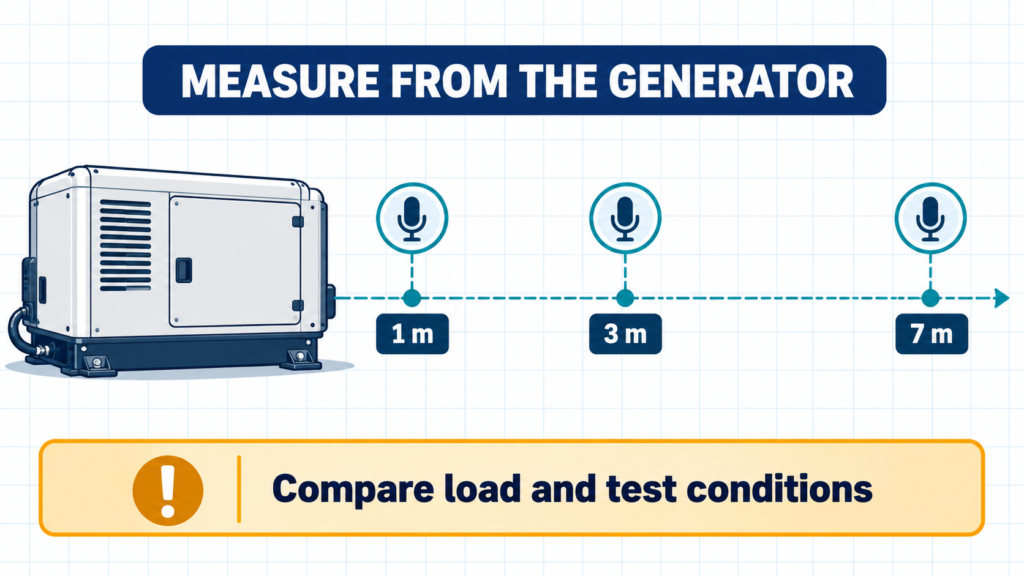
If a specification does not give the distance or configuration, ask the supplier or manufacturer. An incomplete rating may still be useful as a product detail, but it’s a weak basis for ranking the quietest marine generators.
Noise changes as it travels through a boat. The machinery-space location, distance to cabins, mounting arrangement, exhaust path, and surrounding structure all affect what reaches people onboard. An enclosed genset close to a berth may be more noticeable there than a louder-rated unit installed farther away with a well-designed mounting and exhaust system.
Yachting Magazine notes that air intake, exhaust type, and mounting can affect noise and vibration. Marine Generator Depot’s buying guide also cautions that a sound enclosure is only one part of the complete noise-control system.
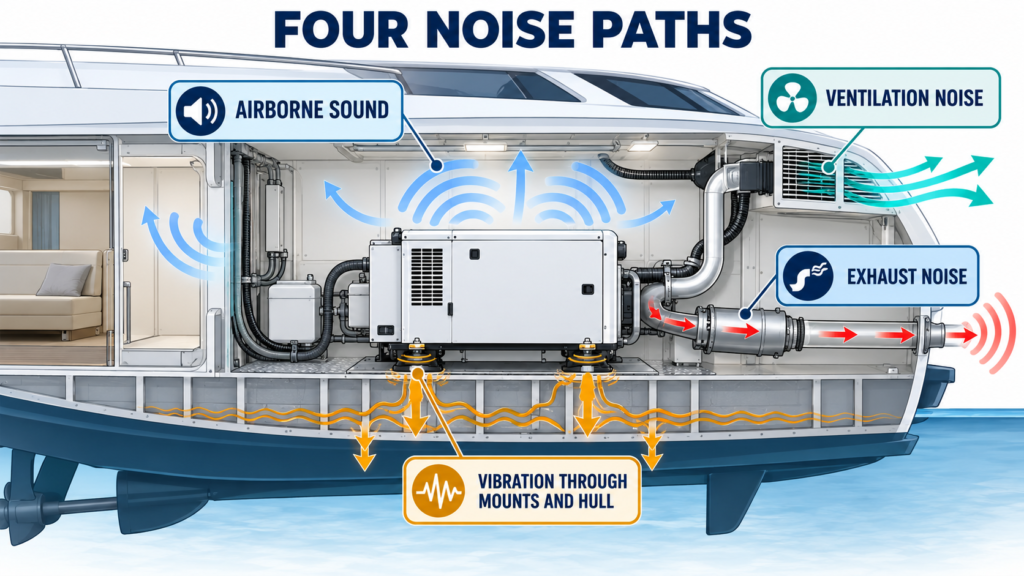
A marine genset can create noise through several paths. Identifying the likely path helps buyers compare features and ask better installation questions.
The engine and alternator produce sound that travels through the air in the machinery space. A marine generator sound shield or acoustic enclosure is designed to reduce some of this mechanical noise. Its performance depends on the particular design and configuration, and it cannot automatically prevent other sources of noise from being heard elsewhere in the boat.
Vibration can pass from the running generator through its mounts and mounting surface into the vessel. Once the hull or nearby panels vibrate, the sound may be noticeable in another compartment—even if the genset is enclosed.
This is why marine generator vibration isolation mounts and the mounting bed deserve attention when you compare models. The correct arrangement depends on the specific generator and installation; don’t assume that a softer mount is always the right choice. The installer should follow the manufacturer’s requirements.
Engine exhaust can create its own sound path. Mufflers, waterlocks, and exhaust routing may form part of the vessel’s noise-control setup, but the installation must also meet the generator manufacturer’s requirements. Yachting Magazine’s installation guidance highlights exhaust and mounting among the factors that can influence onboard noise and vibration.
Generators need adequate cooling and combustion air. Depending on the design, ventilation airflow and cooling components may add to the sound in the machinery space. Don’t evaluate an acoustic enclosure as though it were separate from the generator’s ventilation needs.
Professional BoatBuilder’s recent installation guidance stresses the importance of providing suitable air and preventing saltwater intrusion through wet-exhaust systems. That makes ventilation and exhaust questions relevant to both noise and the overall installation—not just comfort.
New clicking, rattling, or vibration can also point to a maintenance or mechanical issue. When evaluating a generator you already own, note what the noise sounds like, when it occurs, and whether it changes with load. Those observations may help a qualified technician distinguish a normal operating sound from a problem that needs attention.
A low-noise genset is a combination of design and installation. A product may have a sound enclosure, but that alone doesn’t tell you what the generator will sound like in a cabin.
A sound-shielded marine generator uses an enclosure to reduce some airborne mechanical noise. Compare the shield’s inclusion, design, maintenance access, and ventilation requirements for the exact model you’re considering.
More enclosure is not automatically better if it restricts required airflow or makes servicing difficult. Professional BoatBuilder notes that temperatures inside insulated sound shields can affect components such as drive belts, reinforcing the need to consider ventilation and service access with noise reduction.
The mounts and the structure beneath them can affect how vibration travels into the boat. Ask whether the candidate generator uses an isolation-mount arrangement, what mounting surface it requires, and whether the installer expects any changes to the existing foundation.
Rehlko describes its proprietary vibration mounts as a feature of its pleasure-craft generators. Treat that as a manufacturer’s design claim, and check the specific model and installation requirements rather than assuming all configurations perform the same way.
The marine generator exhaust system can contribute to sound outside the machinery space. Ask what muffler or waterlock arrangement is included, what exhaust routing the manufacturer specifies, and whether your boat’s current setup can be retained. Exhaust changes should be planned for the particular genset and vessel, not improvised as a soundproofing fix.
Some variable-speed marine generators adjust engine speed to match electrical demand. That can reduce engine speed during certain low-load operating conditions. For example, Fischer Panda says its iSeries changes speed with demand and publishes a 52–54 dB(A) range at 7 metres. Those are manufacturer-published claims; compare them with other models only when the measurement conditions are clear.
Variable speed is one feature to evaluate, not a shortcut to choosing a generator. You still need to confirm output, electrical compatibility, load profile, installation fit, and service support.
There is no defensible brand-wide “quietest” ranking without comparable tests of exact models under the same conditions. Use brand and model families to build a shortlist, then compare their current specifications and sound-control packages.
| Brand or product family | What to compare |
|---|---|
| Cummins Onan Quiet Diesel | The exact model’s published noise information, whether the sound shield is included, configuration, and dealer support where you cruise. Don’t treat “Quiet Diesel” in a product name as a comparative measurement. |
| Fischer Panda iSeries and encapsulated models | Published dB(A) rating and distance, variable-speed operation, enclosure, output configuration, and service availability. Attribute sound figures to the manufacturer. |
| Kohler/Rehlko marine generators | Sound-shield configuration, air management, vibration mounts, service access, and model-specific specifications. Rehlko describes its shield and vibration-control features as noise-reduction measures. |
| Northern Lights, Paguro, Mase, and WhisperPower | Exact model ratings and measurement conditions, enclosure options, installation requirements, and parts and service coverage for your operating area. |
When comparing marine generator noise levels, keep the table model-specific. Product specifications can vary by voltage, frequency, output, and options, so one model’s rating should not be generalized to an entire brand.
The best fit depends on more than boat length. Think about the loads you run, how often the genset operates, where it sits relative to cabins, and which service providers you can reach.
A sailboat owner may prioritize a compact marine generator, low noise near the sleeping cabin, manageable weight, and dependable battery charging. Limited machinery-space access matters too: a compact unit can still be a poor choice if it is difficult to install or service in the available space.
If air conditioning is a regular load, compare generator output and starting requirements alongside sound-control features. Consider where the generator is located relative to sleeping areas and whether the likely operating schedule includes overnight use.
Longer operating hours make service access, parts availability, and support in the cruising region especially important. A quiet operating profile matters, but so do the maintenance requirements and the time required to obtain service or parts.
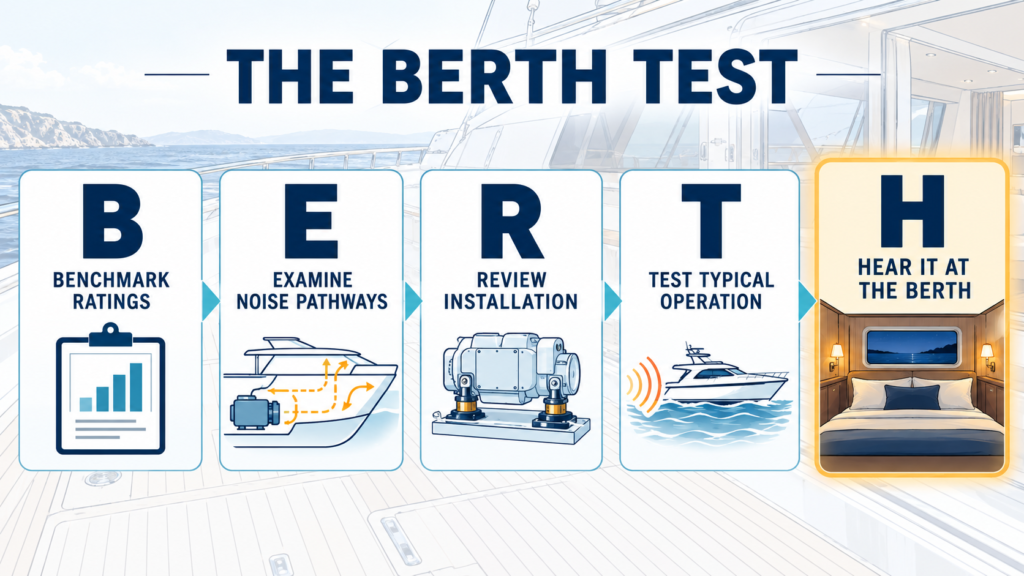
A generator’s dB(A) number can help narrow a shortlist, but it doesn’t tell you what you will hear in the cabin. Use this BERTH test to assess quietness where it matters: onboard. It’s an original buyer’s framework, not an industry standard or laboratory rating.
| Step | Check | What to do |
|---|---|---|
| B | Benchmark ratings consistently | Compare dB(A) figures only when distance, load, and configuration are stated and reasonably similar. |
| E | Examine noise pathways | Consider airborne sound, vibration through the vessel, exhaust noise, and ventilation. |
| R | Review the installation | Check the sound shield, mount arrangement, service access, ventilation, and exhaust plan. |
| T | Test typical operation | Consider the loads and times when you usually run the generator, including overnight or at anchor. |
| H | Hear it at the berth | Focus on likely sound and vibration in sleeping and living areas, not only beside the genset. |
Use each step to record what you know, what needs confirmation, and what could be a deal-breaker. If the supplier can’t confirm a sound-rating condition or installation requirement, mark it as an open question rather than assuming the most favorable answer.
The key insight: The quietest generator on a specification sheet may not produce the quietest experience aboard. If the main noise path is through the mounts, hull structure, or exhaust, replacing the genset alone may not solve the problem.
A battery-inverter system can supply some AC loads without running a generator at that moment. The batteries still need recharging, though, and the system must be designed around the vessel’s actual energy use.
Professional BoatBuilder notes that batteries, alternators, and renewable charging may cover some everyday energy needs, while larger AC loads such as air conditioning can change the calculation substantially. Fischer Panda also describes integrating a generator, battery bank, and inverter as a hybrid onboard architecture.
Before choosing a marine generator and inverter system, consider:
An inverter can make some periods aboard quieter by letting the generator remain off. It does not automatically replace a generator for sustained high electrical demand.
Before requesting a quote or choosing a quiet marine generator, gather the details that determine whether the model and its acoustic package suit your boat.
Have the installer check the specific generator manual and vessel arrangement. Marine generator installation involves cooling, exhaust, fuel, and electrical integration—not just placing the new unit on existing mounts.
Confirm the generator’s output, voltage, frequency, and phase match the vessel’s system and intended use. Also ask about parts availability, service support in the region where you cruise, warranty conditions, and what the quote includes.
Generator exhaust also makes carbon-monoxide safety part of the buying and installation discussion. The U.S. Coast Guard advises boaters to maintain fresh-air circulation and know where engine and generator exhaust outlets are located.
There is no universal quietest marine generator for every vessel. Compare the exact models’ sound ratings, measurement distance, operating conditions, enclosure, vibration control, and installation. A published number by itself cannot establish which generator will sound quietest at a particular berth.
It means the stated sound level was measured 7 metres from the generator under the manufacturer’s test conditions. Ask for the operating load and configuration, and don’t treat it as a prediction of the sound level inside your cabin.
For many boats, an enclosure can reduce some airborne mechanical noise. It does not necessarily eliminate exhaust noise or vibration transmitted through the boat. Compare the enclosure, ventilation, service access, mounts, and exhaust arrangement as parts of the full installation.
They can reduce engine speed when electrical demand is lower, which may reduce noise during those operating periods. The result depends on the model and load. Check the manufacturer’s data and confirm the generator can meet the vessel’s peak and continuous requirements.
Possibly, but first identify the noise path. A technician can help determine whether the main issue is airborne engine noise, vibration transmission, exhaust, or a mechanical problem. If vibration or exhaust dominates, replacing the generator alone may not address the cause.
They can help reduce vibration transmitted into the mounting structure when correctly selected and installed for the generator. They are one element of the installation, not a guaranteed fix for every kind of noise.
Fuel type alone is not enough to predict which generator will be quieter. Compare the exact generator design, enclosure, operating conditions, installation, and support requirements. For either fuel type, exhaust and carbon-monoxide safety need careful attention.
They can reduce generator runtime for some loads, but whether they can replace a genset depends on energy demand, battery capacity, recharging sources, and how long high-power equipment must run. Evaluate the entire onboard power system before deciding.
A quiet yacht generator is not simply the one with the lowest number in a product listing. Compare sound data under stated conditions, look at how noise can travel through the boat, and assess the planned installation at the berth and living spaces.
Use the BERTH test to structure the comparison: benchmark ratings, examine noise pathways, review installation, test typical operation, and consider what people will hear onboard.
For help narrowing down options, contact Marine Generator Depot with your vessel make and model, existing generator details, electrical requirements, machinery-space dimensions, cruising region, and noise priorities. That information gives the team a useful starting point for discussing suitable generator models and installation questions.
